Introduction
Choosing the right mining hardware is the most consequential financial decision a crypto miner makes. The difference between a profitable operation and one that loses money every month often comes down to which machine was purchased and how efficiently it converts electricity into hashing power.
In 2025 the mining hardware landscape looks quite different from two years ago. A new generation of ASIC miners has pushed efficiency to record levels. The GPU mining ecosystem rebuilt itself after Ethereum moved to Proof of Stake in 2022. Electricity cost remains the dominant factor determining whether any hardware is worth running at all.
This guide provides a clear factual comparison of the leading hardware options available in 2026.
ASIC Miners: Pros Cons and Top Models
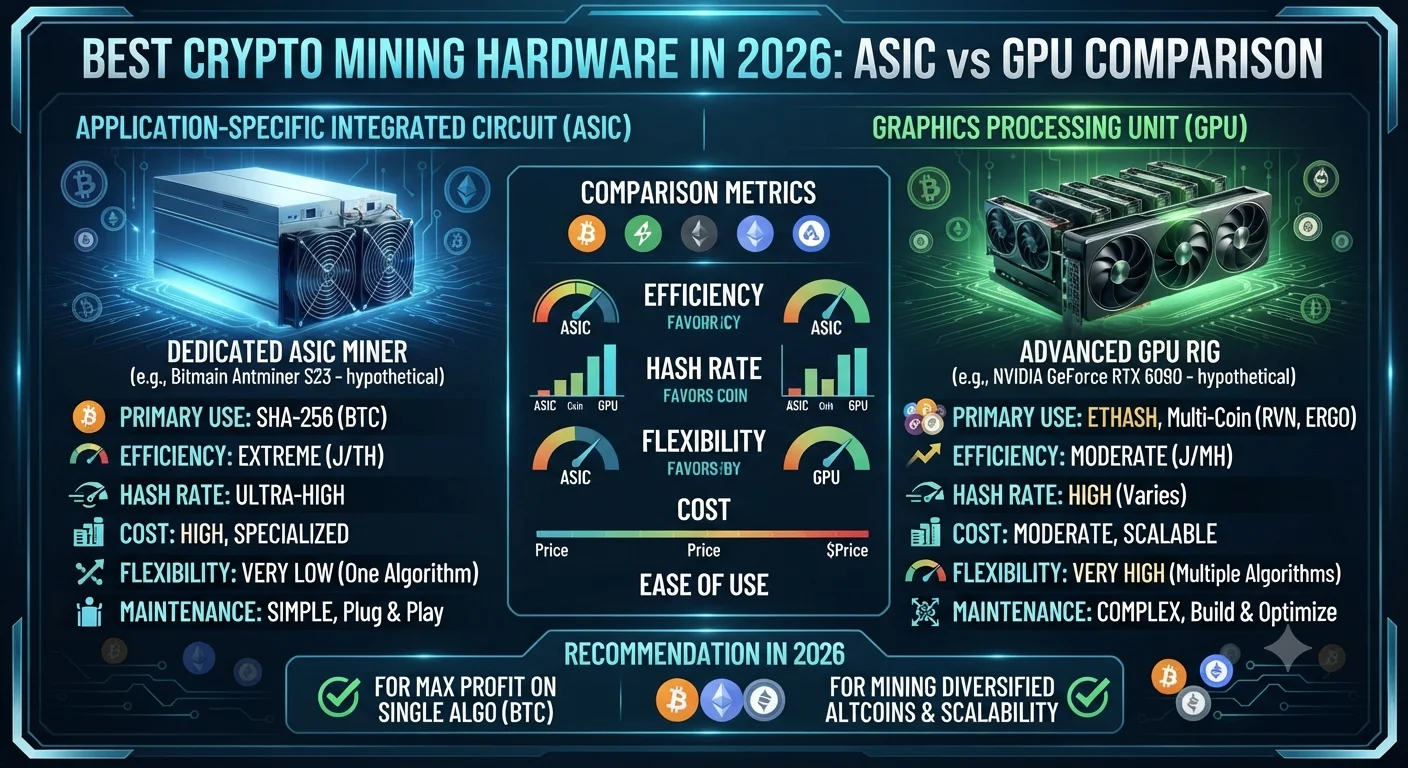
An ASIC miner is a device built for one purpose only. The chip inside is designed at the hardware level to compute a specific cryptographic algorithm as efficiently as physically possible. For Bitcoin mining which uses the SHA-256 algorithm ASICs are not just better than GPUs. They operate in a completely different category of performance.
The advantages of ASICs are significant. They offer the highest hash rate per unit of floor space. They consume less power per unit of hash rate than any alternative. They require minimal technical configuration beyond initial network setup. For Bitcoin specifically they are the only hardware capable of competing at any meaningful scale in 2026.
The disadvantages are equally real. ASICs are algorithm specific. An Antminer S21 can only mine SHA-256 coins. If you want to mine Monero or Kaspa you need entirely different hardware. ASICs also depreciate rapidly as newer more efficient models arrive. A machine generating strong returns today may be unprofitable within 18 months when the next generation ships. ASICs have essentially no secondary market value outside of mining.
Top ASIC Models Available in 2026
The Bitmain Antminer S21 Pro is the flagship Bitcoin ASIC as of mid 2026. It delivers 234 terahashes per second at a power consumption of approximately 3510 watts giving an efficiency rating of around 15 joules per terahash. This represents a significant improvement over previous generations and makes it one of the most competitive machines for large scale Bitcoin mining.
The MicroBT Whatsminer M60S is a strong competitor. It produces approximately 186 terahashes per second at around 3441 watts. Its efficiency is slightly behind the S21 Pro but it has a strong reputation for build quality and reliability in continuous operation.
The Bitmain Antminer L9 is designed for Scrypt algorithm mining which covers Litecoin and Dogecoin through merge mining. It delivers 16 gigahashes per second at around 3360 watts and remains one of the most profitable ASIC options for miners seeking exposure to LTC and DOGE.
The Jasminer X16-P is designed for the Etchash algorithm used by Ethereum Classic. It produces approximately 2.5 gigahashes per second at just 1200 watts making it one of the most energy efficient options for ETC mining in 2026.
GPU Mining: Which Cards Remain Viable?
Graphics processing units are general purpose parallel computing devices. Because they can be reprogrammed to compute different algorithms they offer flexibility that ASICs cannot match. A GPU mining rig can switch from mining Kaspa to Ravencoin to Ethereum Classic in minutes based on profitability signals.
After Ethereum moved to Proof of Stake the GPU mining market went through a painful adjustment period. Millions of cards flooded the second hand market. Many small miners exited entirely. In 2025 a dedicated GPU mining community persists and certain coins have emerged as sustainable targets.
NVIDIA RTX 4090
The RTX 4090 remains the most powerful single GPU for mining. On the KHeavyHash algorithm used by Kaspa it achieves approximately 15 gigahashes per second at around 320 watts giving it a strong efficiency ratio. Its retail price makes the ROI timeline long unless electricity costs are very low but it remains the performance benchmark.
NVIDIA RTX 3080 and RTX 3090
These cards from the previous generation represent better value for miners looking to buy second hand hardware. They are available at significantly lower prices than their original retail cost and still deliver respectable performance on most GPU minable algorithms. For a miner building a rig on a budget these cards offer a practical entry point.
AMD RX 7900 XTX
The AMD flagship competes well on certain algorithms particularly those favouring AMD's memory bandwidth advantages. For Ethereum Classic mining on the Etchash algorithm AMD cards have historically shown strong performance relative to power consumption making them worth evaluating alongside NVIDIA options.
The key consideration when evaluating any GPU for mining is not raw hash rate in isolation. It is the efficiency ratio expressed as megahashes per watt. A card that produces more hashes while consuming fewer watts will always be more profitable than a faster but less efficient alternative when electricity costs are equal.
How to Calculate Mining ROI
Return on investment in mining is calculated by comparing the revenue your hardware generates against the costs of running it. These costs include the initial hardware purchase and ongoing electricity expenses.
Recommended Articles
 CRYPTO MINING
 CRYPTO MINING
 CRYPTO MINING
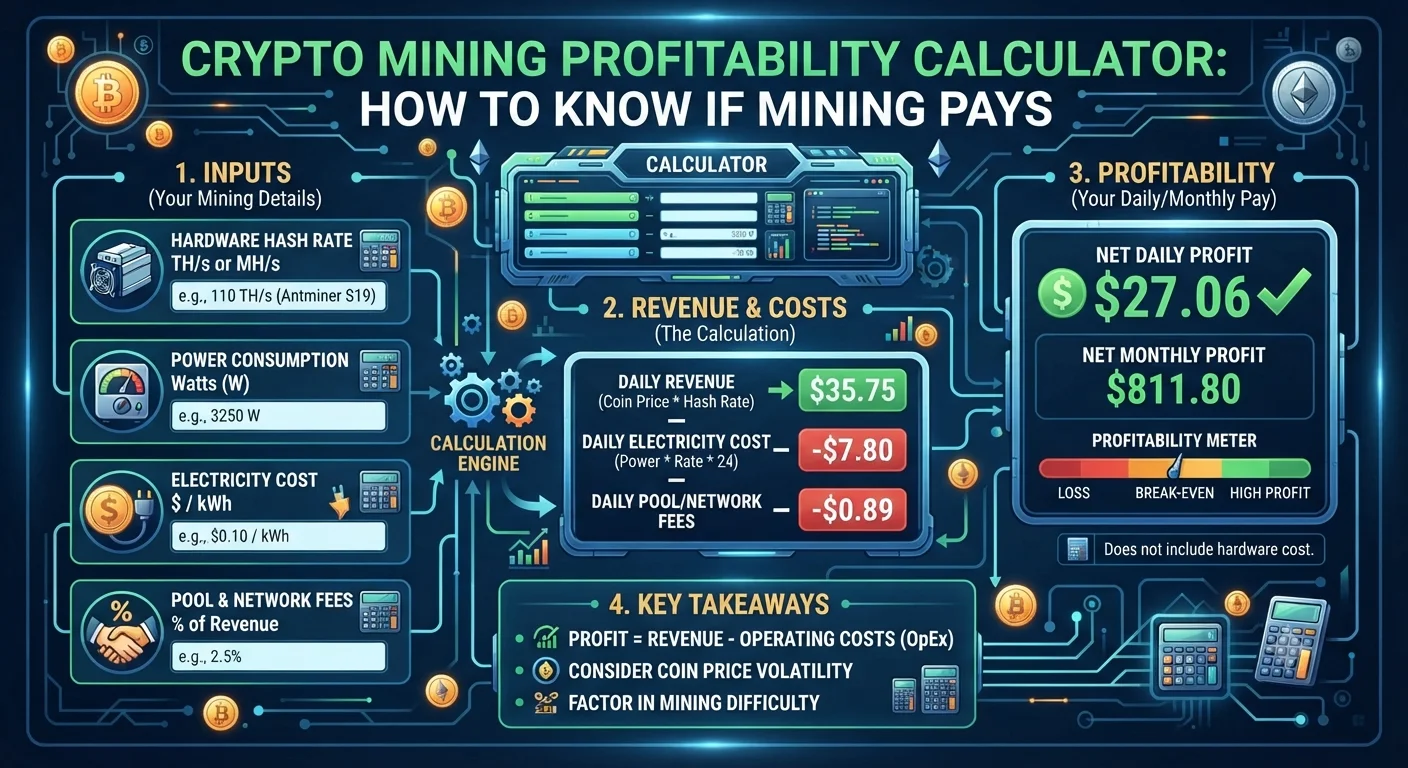
The basic calculation works as follows. Your daily revenue equals your hash rate divided by the total network hash rate multiplied by the daily block reward multiplied by the current coin price. This gives your daily revenue in fiat terms before electricity costs.
Your daily electricity cost equals your hardware power consumption in kilowatts multiplied by your electricity rate per kilowatt hour multiplied by 24 hours.
Your daily profit is daily revenue minus daily electricity cost.
Your break even point in days is the total hardware cost divided by daily profit.
The challenge is that every variable in this calculation changes constantly. Network difficulty adjusts as more miners join or leave. Coin prices fluctuate. Block rewards halve on fixed schedules. A calculation done today produces a different answer in 30 days.
This is why experienced miners use tools like WhatToMine and the NiceHash Profitability Calculator. These platforms pull live network data and electricity prices to give real time estimates. They do not predict the future but they provide an accurate snapshot of current profitability for any given hardware and electricity cost combination.
Power Consumption and Electricity Costs
Electricity is the primary cost in mining and the primary determinant of profitability. Getting this right matters more than almost any other decision a miner makes.
At a residential electricity rate of 0.12 dollars per kilowatt hour running an Antminer S21 Pro consuming 3510 watts costs approximately 10.11 dollars per day. At 0.05 dollars per kilowatt hour the same machine costs 4.21 dollars per day. That difference of nearly six dollars per day compounds to over two thousand dollars per year. Across a fleet of ten machines the difference from electricity costs alone exceeds twenty thousand dollars annually.
This arithmetic explains why industrial Bitcoin mining operations locate near cheap power sources. Hydroelectric facilities in Scandinavia and Canada. Stranded natural gas operations in Texas and North Dakota. Geothermal energy in Iceland. The goal is always to reduce electricity cost because it is both unavoidable and directly proportional to the number of machines running.
For home miners the honest assessment in 2026 is that Bitcoin mining at standard residential electricity rates in most countries is very difficult to make profitable. The more realistic opportunity for home miners lies in altcoin mining where lower network difficulty and lower hardware costs can produce better returns at higher electricity prices.
Where to Buy Mining Hardware Safely
Mining hardware can be purchased through several channels and not all of them are equally trustworthy.
Buying directly from the manufacturer is the safest option. Bitmain sells through its official website. MicroBT sells through whatsminer.com. Buying direct ensures genuine hardware with manufacturer warranty support. The downside is that popular models often sell out quickly and waitlists can extend for months on newly released hardware.
Authorised resellers are the next best option. Both Bitmain and MicroBT maintain networks of certified resellers in major markets. Verify reseller status directly on the manufacturer website before purchasing from any third party.
The second hand market through platforms like eBay and dedicated mining hardware marketplaces offers lower prices but carries more risk. Test any second hand machine thoroughly on arrival. Request original purchase documentation where possible. Be cautious of deals priced significantly below market rate as counterfeits and damaged units are common in the grey market.
Avoid any seller offering pre order hardware at guaranteed prices far below market rate. Advance payment scams targeting miners are well documented and particularly common when new generation hardware is announced but not yet shipping.
Conclusion
The best mining hardware for any individual operation depends on three factors. What coin you want to mine. What electricity rate you have access to. And how much capital you can commit to both hardware and ongoing operating costs.
For Bitcoin mining in 2026 the Bitmain Antminer S21 Pro leads the field in efficiency but demands access to low cost electricity to generate meaningful returns. For altcoin and GPU mining the landscape is more varied and the opportunity for smaller operators is greater.
Before purchasing any hardware run the numbers honestly using live profitability calculators. Account for difficulty increases over time. Build a conservative scenario alongside an optimistic one. The miners who stay profitable through market cycles are not the ones who bought the most hardware. They are the ones who understood their costs before they plugged in a single machine.
Disclaimer: This article is for educational and informational purposes only. Hardware specifications and profitability figures are accurate as of the publication date and are subject to change. Crypto mining involves significant financial risk. Conduct thorough research before purchasing mining equipment.
Related Articles: What is Crypto Mining? How Bitcoin and Altcoin Mining Really Works Crypto Mining Profitability Calculator: How to Know if Mining Pays Bitcoin Halving Explained: What It Means for Miners and Investors