Introduction
Every day, more than $7.5 trillion changes hands in the foreign exchange market — making it the largest and most liquid financial market on the planet. That figure dwarfs the stock market, the bond market, and every commodity exchange combined.
Yet for most people, forex trading remains a mystery wrapped in jargon: pips, spreads, leverage, currency pairs. If you have ever wondered what forex trading actually is, how it works, and whether it is something you could realistically learn — this guide is your starting point.
By the end, you will understand exactly how the forex market operates, who the key players are, what currency pairs mean, when markets are open, and what steps a beginner needs to take before placing their first trade.
What is the Forex Market?
- Introduction
- What is the Forex Market?
- A Brief History of Forex
- How Forex Trading Works Step by Step
- What is a Broker in Forex?
- Key Forex Market Participants
- Major, Minor, and Exotic Currency Pairs
- Understanding Forex Market Hours
- What Beginners Need to Know Before Their First Trade
- Common Forex Trading Mistakes to Avoid
- Conclusion
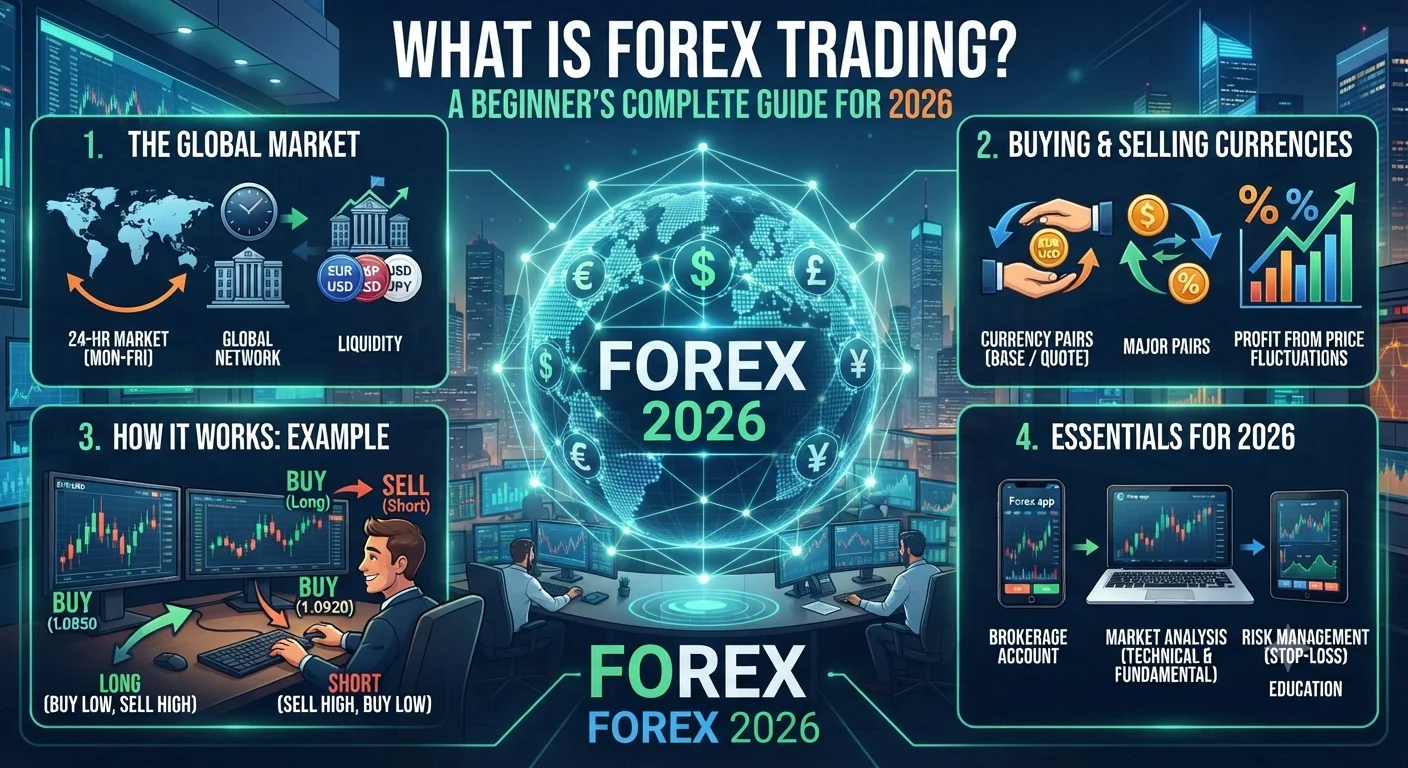
Forex is short for foreign exchange. The forex market is a global, decentralized marketplace where currencies are bought and sold against one another. Unlike the New York Stock Exchange or the London Stock Exchange, there is no single physical building where forex trading happens. Instead, it operates through an electronic network of banks, brokers, financial institutions, and individual traders spread across every time zone on Earth.
The purpose of the forex market, at its most fundamental level, is to enable currency conversion. When a business in Germany buys machinery from Japan, it must convert euros into yen. When a tourist from the United Kingdom holidays in Thailand, they exchange pounds for baht. These are all forex transactions.
For traders, however, the goal is different: to profit from the constantly shifting exchange rates between currencies.
A Brief History of Forex
The modern forex market was born in 1971 when the Bretton Woods Agreement collapsed. Before that point, most currencies were pegged to the US dollar, which was itself pegged to gold. When the United States ended the gold standard under President Nixon, currencies began to float freely against one another — and the forex market as we know it emerged.
Since the 1990s, internet technology has opened the market to retail (individual) traders. Today, anyone with a laptop, a broker account, and a modest deposit can participate in the same market that central banks and multinational corporations use every day.
How Forex Trading Works Step by Step
Forex trading is the act of speculating on whether one currency will rise or fall in value relative to another. Here is the basic mechanics:
Step 1 — You choose a currency pair. Forex is always traded in pairs. You are simultaneously buying one currency and selling another. The most traded pair in the world is EUR/USD — the euro against the US dollar.
Step 2 — You decide on a direction. If you believe the euro will strengthen against the dollar, you buy EUR/USD (this is called going long). If you believe the euro will weaken, you sell EUR/USD (going short).
Step 3 — The price moves. Exchange rates change continuously, driven by economic data, central bank decisions, geopolitical events, and market sentiment.
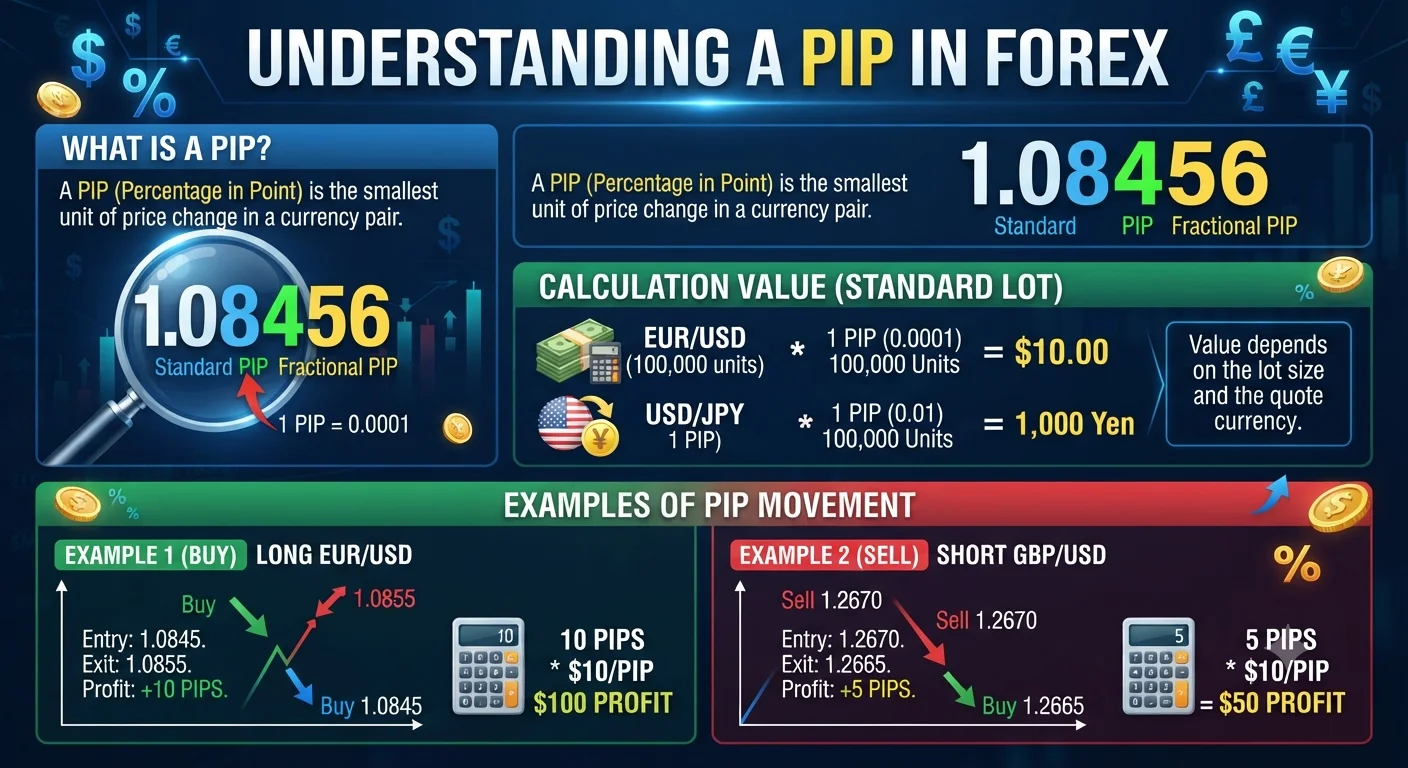
Step 4 — You close your trade. When you close a trade, your profit or loss is calculated based on how far the price moved from your entry point to your exit point, measured in pips.
Step 5 — Settlement. Your broker calculates your gain or loss in your account currency and adjusts your balance accordingly.
It sounds straightforward — and conceptually it is. The challenge lies in predicting which direction prices will move and managing your risk when they move against you.
What is a Broker in Forex?
A forex broker is the intermediary between you and the interbank market — the network of large banks that actually execute currency transactions at wholesale rates. Brokers provide retail traders with access to prices, execution, charts, and leverage. They earn money through the spread (the difference between the buy and sell price) or through commissions on each trade.
Choosing a properly regulated broker is one of the most important decisions a new trader makes. Regulatory bodies such as the FCA (UK), CFTC (USA), and ASIC (Australia) ensure brokers hold client funds separately and meet minimum capital requirements.
Key Forex Market Participants
The forex market is not dominated by retail traders like you and me. Understanding who the major participants are — and why they trade — gives important context.
Central Banks are the most powerful participants. Institutions such as the US Federal Reserve, the European Central Bank, and the Bank of Japan influence exchange rates through interest rate decisions, quantitative easing programs, and direct currency intervention. When the Fed raises interest rates, it typically strengthens the US dollar because higher yields attract foreign capital.
Commercial and Investment Banks make up the interbank market, where the majority of forex volume is traded. Banks trade on behalf of clients and also speculate with their own capital.
Corporations and Multinational Companies trade forex to hedge currency risk. An American company that sells products in Europe needs to convert euro revenue back into dollars — and uses the forex market to lock in exchange rates in advance.
Hedge Funds and Asset Managers trade forex as part of global investment strategies, often taking large positions based on macroeconomic research.
Retail Traders — individual people like you — represent a small but growing share of overall volume, made possible by the rise of online brokers and accessible trading platforms.
Major, Minor, and Exotic Currency Pairs
Every forex trade involves a currency pair — one currency measured in terms of another. Pairs fall into three categories:
Recommended Articles
 FOREX TRADING
 FOREX TRADING
 FOREX TRADING
 FOREX TRADING
Major pairs include the world's most heavily traded currencies, all paired against the US dollar. Examples: EUR/USD, GBP/USD, USD/JPY, USD/CHF, AUD/USD, USD/CAD, NZD/USD. Majors have the tightest spreads and highest liquidity, making them ideal for beginners.
Minor pairs (also called cross pairs) are pairs that do not include the US dollar. Examples: EUR/GBP, EUR/JPY, GBP/JPY. These are slightly less liquid but still widely traded.
Exotic pairs combine a major currency with the currency of an emerging or smaller economy. Examples: USD/TRY (Turkish lira), USD/ZAR (South African rand), USD/MXN (Mexican peso). Exotic pairs have wider spreads and higher volatility — not recommended for beginners.
As a beginner, you should focus exclusively on major pairs. EUR/USD alone accounts for roughly 23% of all daily forex volume, ensuring excellent liquidity and tight spreads at all hours.
Understanding Forex Market Hours
One of the unique features of the forex market is that it operates 24 hours a day, five days a week — from Sunday evening (when markets open in Sydney, Australia) to Friday evening (when New York closes). This is possible because major financial centres around the world operate in overlapping time zones.
The four main trading sessions are:
| Session | Opens (GMT) | Closes (GMT) | Key Currencies |
|---|---|---|---|
| Sydney | 10:00 PM | 7:00 AM | AUD, NZD |
| Tokyo | 12:00 AM | 9:00 AM | JPY, AUD |
| London | 8:00 AM | 5:00 PM | EUR, GBP, CHF |
| New York | 1:00 PM | 10:00 PM | USD, CAD |
The highest trading volume — and therefore the most price movement — occurs when two sessions overlap. The London-New York overlap (1:00 PM to 5:00 PM GMT) is the most active period of the trading day, making it particularly attractive for day traders.
Markets are closed on weekends. When they reopen on Sunday evening, there is sometimes a price gap if significant news occurred during the closure.
What Beginners Need to Know Before Their First Trade
Forex trading carries real financial risk. The majority of retail traders lose money, particularly in their early months. Before you deposit any real capital, here are the foundations you must build:
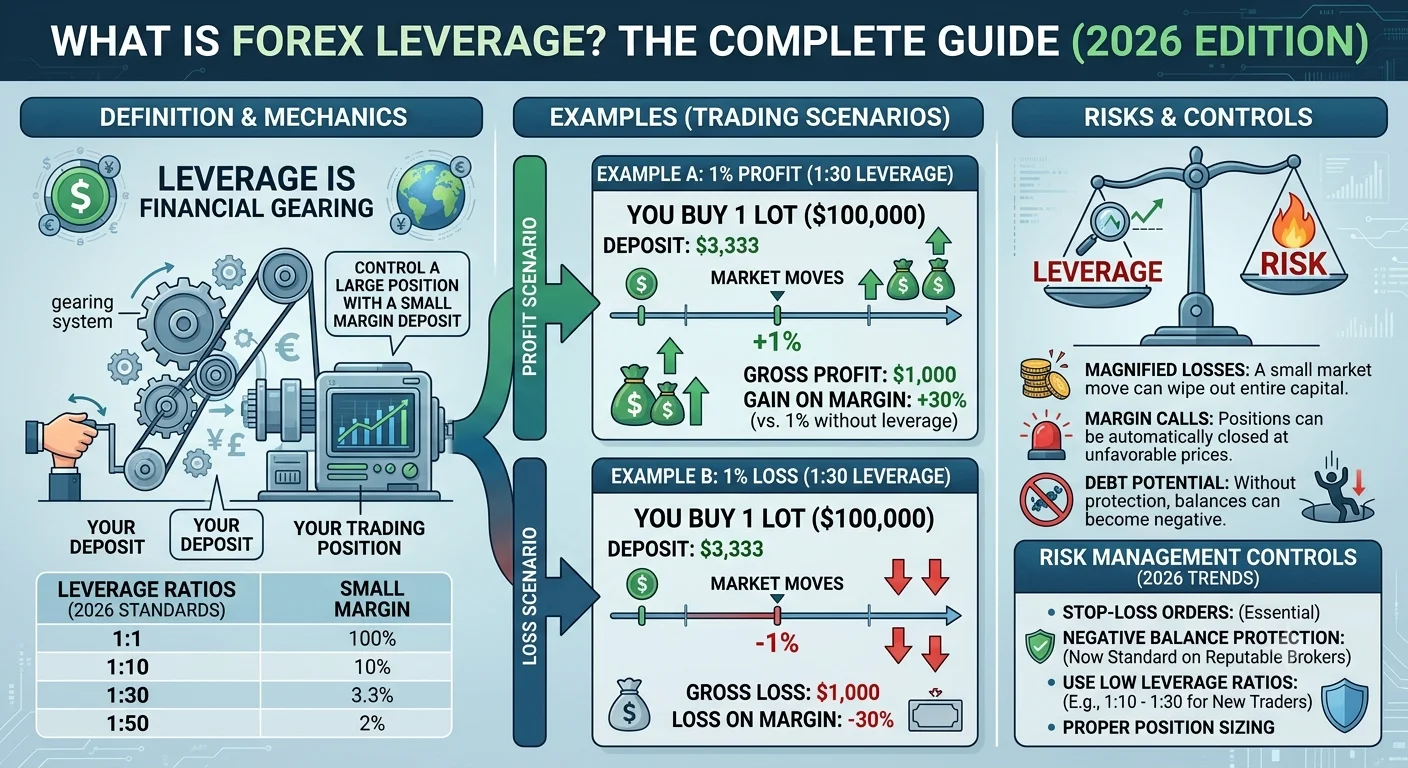
Understand leverage. Forex brokers offer leverage — the ability to control a large position with a small deposit. While leverage magnifies potential profits, it equally magnifies losses. A 100:1 leverage ratio means a 1% adverse move wipes out your entire deposit. Beginners should use minimal leverage or none at all until they have demonstrated consistent results on a demo account.
Learn risk management first. Before studying trading strategies, study risk management. The 1% rule — never risking more than 1% of your account on a single trade — is the foundation that keeps losing streaks survivable.
Trade a demo account. Every reputable broker offers a free demo account with simulated funds. Practice there for at least 30 to 60 days before touching real money. There is no shortcut to this step.
Study the basics of technical and fundamental analysis. Technical analysis uses price charts and indicators to identify trading opportunities. Fundamental analysis uses economic data — interest rates, inflation, employment figures — to assess currency value. Most traders use a combination of both.
Keep a trading journal. From your very first demo trade, record your entry, exit, reasoning, and the outcome. Reviewing your journal weekly reveals patterns in both your winning and losing trades that no course or book can teach you.
Common Forex Trading Mistakes to Avoid
Overleveraging is the single most common cause of blown accounts among new traders. Using maximum leverage turns the forex market into a casino. Treat leverage as a tool for capital efficiency, not for gambling.
Trading without a stop loss leaves your account exposed to unlimited downside on any single trade. Every trade you place should have a predetermined maximum loss — your stop loss — set before you enter.
Chasing losses — doubling down after a losing trade to recover quickly — is one of the most destructive psychological patterns in trading. Accept that losses are part of the process, not emergencies to be fixed immediately.
Overtrading — placing too many trades out of boredom or the fear of missing out — generates excessive spread costs and leads to poor decision-making. Quality over quantity is a cardinal rule in forex.
Ignoring the economic calendar — entering a trade just before a major data release like Non-Farm Payrolls or a central bank decision is a common beginner mistake. High-impact events cause sudden, unpredictable price spikes. Until you understand how to trade around news, avoid being in open positions during scheduled releases.
Conclusion
Forex trading is not a get-rich-quick scheme. It is a skill — one that takes time, study, practice, and discipline to develop. The traders who consistently profit are not the ones with the best predictions; they are the ones with the best risk management and the most consistent process.
The good news is that the forex market is genuinely accessible. With a well-regulated broker, a demo account, and a commitment to learning, you have everything you need to start building that foundation.
Your next step: learn what a pip is and how pip value is calculated — it is the unit of measurement that defines every profit and loss in forex trading.
Disclaimer: This article is for educational and informational purposes only. It does not constitute financial or investment advice. Forex trading involves significant risk of loss and is not suitable for all investors. Always conduct your own research and consider seeking independent financial advice before trading.