Introduction
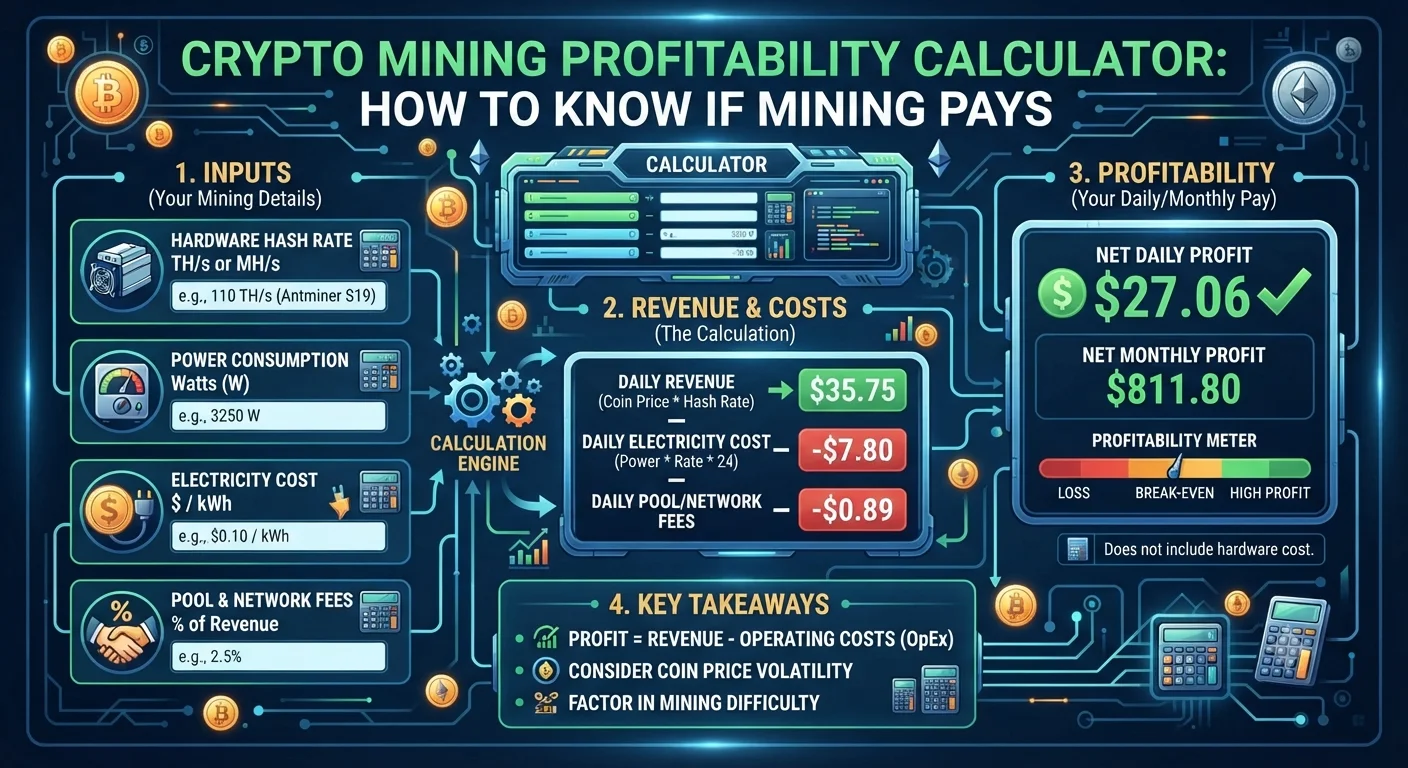
Mining profitability is not a fixed number. It is a calculation that changes every day based on four variables that are constantly in motion. Understanding how those variables interact is the difference between a miner who makes informed decisions and one who buys hardware on optimism and wonders why the numbers do not work out.
This guide breaks down exactly how to calculate crypto mining profitability. You will learn what each variable means why it matters and how to use free online tools to get an accurate picture of whether mining a particular coin with particular hardware at your specific electricity cost makes financial sense right now.
The Four Variables of Mining Profitability
- Introduction
- The Four Variables of Mining Profitability
- Variable 1: Hash Rate
- Variable 2: Electricity Cost
- Variable 3: Network Difficulty
- Variable 4: Coin Price
- How to Use Free Mining Calculators Online
- WhatToMine
- NiceHash Profitability Calculator
- CryptoCompare Mining Calculator
- Mining Pool Calculators
- Calculating Your Break Even Point
- When to Stop Mining a Coin
- Pool Fees and Their Impact
- Seasonal Electricity Rate Strategies
- Conclusion
Every mining profitability calculation reduces to four inputs. Changing any one of them changes the outcome significantly.
Variable 1: Hash Rate
Hash rate is the measure of your mining hardware's computational power. It tells you how many hash calculations your machine performs per second. Higher hash rate means a greater share of the network's total block discovery probability.
Hash rate is measured in units appropriate to the algorithm being mined. For Bitcoin on SHA-256 the standard unit is terahashes per second (TH/s). For Kaspa on KHeavyHash the unit is gigahashes per second (GH/s). For Monero on RandomX the unit is kilohashes per second (KH/s).
Your individual hash rate determines your proportional share of the total network hash rate. If the Bitcoin network operates at 700 exahashes per second and your miner produces 200 terahashes per second your share of total network reward is 200 TH/s divided by 700,000,000 TH/s which is an extremely small fraction. Multiplied by the daily block reward total this fraction gives your expected daily earnings before costs.
Variable 2: Electricity Cost
Electricity cost is expressed as a rate per kilowatt hour and it is the single most important profitability variable for the majority of miners. Unlike hash rate which is fixed by your hardware and unlike coin price or difficulty which you cannot control electricity cost is the variable most directly influenced by your location and business decisions.
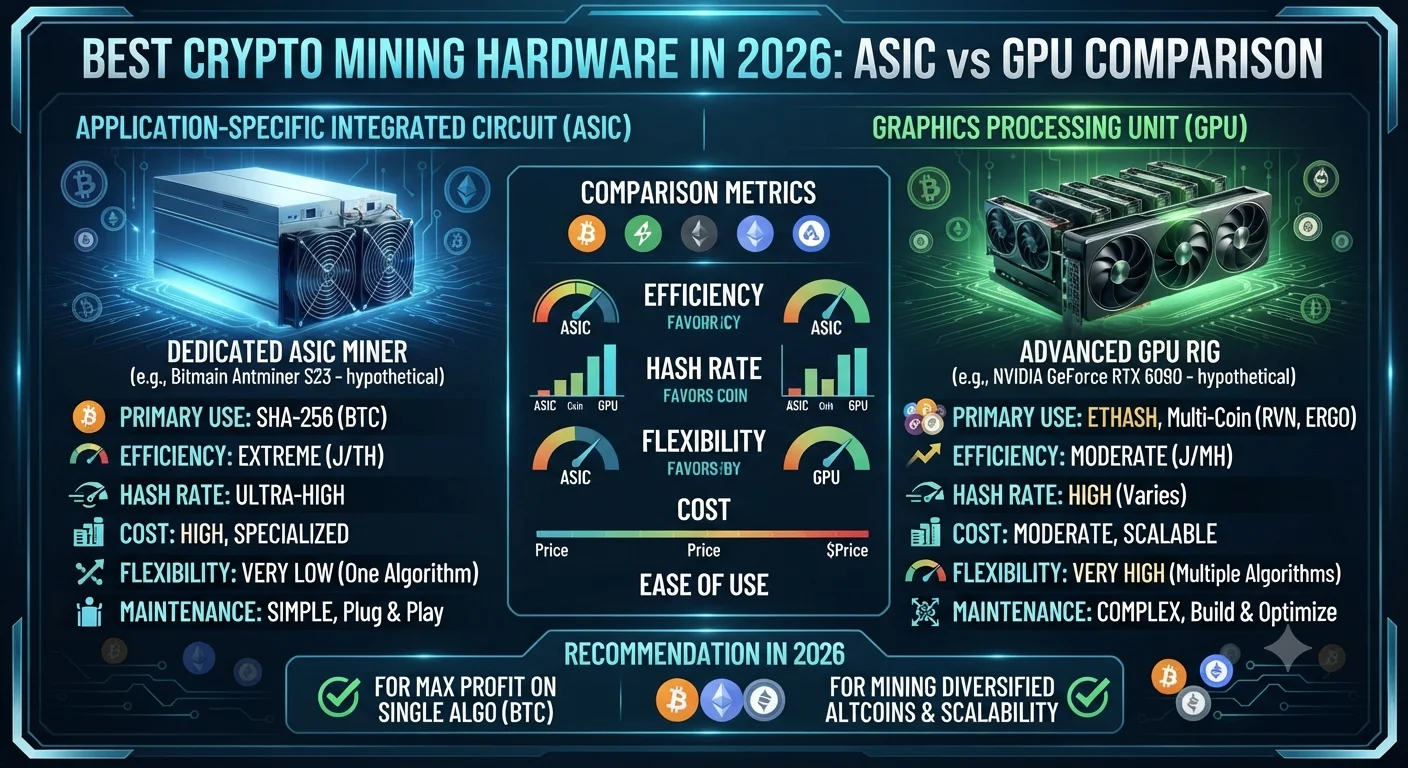
- Best Crypto Mining Hardware in 2026: ASIC vs GPU Comparison
- What is Crypto Mining? How Bitcoin and Altcoin Mining Really Works
To calculate your daily electricity cost: multiply your hardware's power consumption in kilowatts by your electricity rate per kilowatt hour by 24 hours in a day.
An Antminer S21 Pro consuming 3.51 kilowatts at 0.07 dollars per kilowatt hour costs 3.51 multiplied by 0.07 multiplied by 24 which equals 5.90 dollars per day in electricity.
The same machine at 0.12 dollars per kilowatt hour costs 3.51 multiplied by 0.12 multiplied by 24 which equals 10.11 dollars per day. That additional 4.21 dollars per day translates to over 1,500 dollars per year per machine in additional cost purely from a higher electricity rate.
Variable 3: Network Difficulty
Network difficulty is a measure of how hard it is to find the next valid block on a proof of work blockchain. Bitcoin adjusts its difficulty every 2,016 blocks which occurs approximately every two weeks. The adjustment is designed to keep average block discovery time at approximately 10 minutes regardless of how much or how little mining power is pointed at the network.
When more miners join the network and total hash rate increases difficulty rises. When miners leave and hash rate falls difficulty decreases. This automatic adjustment means that as an individual miner your share of block rewards shrinks when new competitors enter the network even if your hardware remains identical.
Rising difficulty is the long term headwind facing all miners. Bitcoin's difficulty has trended upward throughout its history as hardware technology has improved and more capital has entered the mining industry. Planning around the assumption that difficulty will remain constant is a common and costly mistake.
Variable 4: Coin Price
The current market price of the coin being mined determines the fiat value of your block rewards. A miner earning 0.001 BTC per day earns 67 dollars at a Bitcoin price of 67,000 and earns 90 dollars at a price of 90,000. Everything else being equal coin price directly multiplies your revenue.
This dependence on coin price is one of the most significant risks in mining. Hardware costs and electricity costs are largely fixed in fiat terms. Revenue is variable and denominated in a volatile asset. A 50% drop in Bitcoin price cuts revenue in half while costs remain unchanged.
How to Use Free Mining Calculators Online
Rather than performing manual calculations for every scenario the most efficient approach is to use the free profitability calculators available online. These tools pull live network data including current difficulty and coin price and allow you to input your hardware specifications and electricity rate to generate real time profitability estimates.
WhatToMine
WhatToMine at whattomine.com is the most comprehensive free mining calculator available. It covers hundreds of mineable coins across multiple algorithms. You enter your GPU or ASIC specifications or select from a preset hardware list enter your electricity rate and the tool calculates estimated daily revenue costs and profit for each coin it tracks. It also ranks coins by current profitability allowing you to identify which algorithm and coin is most profitable for your specific hardware at any given time.
WhatToMine is particularly valuable for GPU miners who have the flexibility to switch between multiple coins and algorithms.
NiceHash Profitability Calculator
The NiceHash calculator at nicehash.com/profitability-calculator is optimised for estimating earnings when selling your hash rate through the NiceHash marketplace rather than mining directly to a pool. It provides a straightforward interface where you select your GPU model from a comprehensive list and receive estimated daily earnings based on current marketplace demand.
Recommended Articles
 CRYPTO MINING
 CRYPTO MINING
 CRYPTO MINING
CryptoCompare Mining Calculator
CryptoCompare offers a clean calculator specifically for Bitcoin and the major proof of work coins. It is useful for quick calculations and provides a clear breakdown of revenue electricity cost and net profit on a daily weekly monthly and annual basis.
Mining Pool Calculators
Most major mining pools including Foundry USA F2Pool and AntPool provide their own embedded profitability calculators on their websites. These calculators use live pool data and may be more accurate for estimating pool specific earnings after pool fees than third party tools.
Calculating Your Break Even Point
The break even point tells you how long your mining hardware must operate profitably before the revenue covers the initial hardware purchase cost. It is the most important long term planning metric for any mining operation.
Break even days equals total hardware cost divided by daily net profit.
If an Antminer S21 Pro costs 4,500 dollars and generates 8 dollars of net daily profit after electricity costs the break even point is 4,500 divided by 8 which equals 562 days or approximately 18 months.
This calculation must be treated as an estimate rather than a guarantee because daily net profit changes constantly as difficulty rises and coin price fluctuates. A more conservative approach is to calculate break even under two scenarios: one using current profitability figures and one using profitability figures 30% lower to account for potential difficulty increases or price drops. If the break even point under the conservative scenario is still within an acceptable timeframe the investment has a reasonable risk profile.
When to Stop Mining a Coin
Knowing when mining is no longer profitable is as important as knowing when to start. Continuing to mine at a loss depletes capital faster than simply holding the coin.
The shutdown price is the coin price below which mining produces a net loss after electricity costs but before any consideration of hardware amortisation. It is the absolute floor below which running the machine makes no economic sense at all.
Shutdown price for a specific miner equals daily electricity cost divided by daily coin output at current difficulty.
If a miner costs 10 dollars per day in electricity and produces 0.00012 BTC per day at current difficulty the shutdown price is 10 divided by 0.00012 which equals approximately 83,333 dollars per Bitcoin. Below this price the machine loses money on electricity alone and should be turned off.
Many sophisticated miners calculate this figure for each machine individually and set automated monitoring to alert them if coin price approaches the shutdown threshold.
Pool Fees and Their Impact
Most miners join a pool rather than mining solo. Pool fees are deducted from your gross revenue before you receive your payout. A pool fee of 2% on daily gross revenue of 12 dollars costs 0.24 dollars per day which totals approximately 87 dollars per year per machine.
While this seems small it compounds meaningfully across a larger mining operation. A fleet of 20 machines with 2% pool fees versus 1% pool fees creates a difference of approximately 1,740 dollars annually solely from the fee differential.
When comparing pools always compare the net payout after fees rather than the fee percentage in isolation. Some pools with lower stated fees use payout methods that expose miners to higher variance in earnings. Others with slightly higher fees offer more predictable daily payouts that simplify financial planning.
Seasonal Electricity Rate Strategies
Electricity rates in many regions are not constant throughout the year. In areas with significant seasonal variation in power demand or renewable energy generation mining profitability can vary substantially by season.
Miners with access to hydroelectric power in regions where water flow peaks during spring and summer may access their lowest electricity rates precisely during the months when renewable generation is highest. Conversely winter heating demand in cold regions can push electricity prices up significantly.
Mapping your electricity rate across all 12 months before committing to a mining operation allows you to build a more accurate annual profitability model rather than assuming a single rate applies year round.
Conclusion
Mining profitability is a dynamic calculation driven by four variables that never stop moving. Hash rate is fixed by your hardware. Electricity cost is determined by your location and contracts. Network difficulty and coin price are outside your control entirely.
The miners who thrive over multiple market cycles are those who run their numbers conservatively before purchasing hardware model multiple scenarios and monitor profitability continuously against the break even and shutdown thresholds relevant to their specific machines.
Use the free tools available. Run the calculations honestly. Include difficulty growth assumptions in your models. And never commit capital to mining hardware based solely on current profitability figures without accounting for how those figures are likely to change over the months ahead.
DISCLAIMER: This article is for educational and informational purposes only. Profitability figures mentioned are illustrative and based on conditions at the time of writing. Crypto mining involves significant financial risk. Always conduct thorough independent research before purchasing mining equipment.
RELATED ARTICLES: Best Crypto Mining Hardware in 2026: ASIC vs GPU Comparison What is Crypto Mining? How Bitcoin and Altcoin Mining Really Works Bitcoin Halving Explained: What It Means for Miners and Investors