Introduction
Few technologies have been simultaneously overhyped, misunderstood, dismissed, and genuinely revolutionary in equal measure. Blockchain is one of them.
Since Bitcoin's white paper introduced the concept in 2008, blockchain has been described as everything from "the internet of money" to "a solution looking for a problem." The truth, as usual, lies somewhere in between — and it starts with understanding what blockchain actually is, stripped of marketing language.
This guide explains blockchain technology from the ground up: what it is, how it works, the different types that exist, and where it is genuinely being used today. Whether you are an investor, a developer, a student, or a curious person who keeps seeing the word in the news, this is the foundation you need.
Blockchain Defined: Beyond the Buzzword
- Introduction
- Blockchain Defined: Beyond the Buzzword
- How a Distributed Ledger Works
- Types of Blockchains: Public, Private, and Consortium
- Public Blockchains
- Private Blockchains
- Consortium Blockchains
- Real-World Blockchain Use Cases
- Blockchain vs Traditional Databases
- Layer 1 vs Layer 2 Blockchains
- Nodes and Consensus Mechanisms
- Conclusion
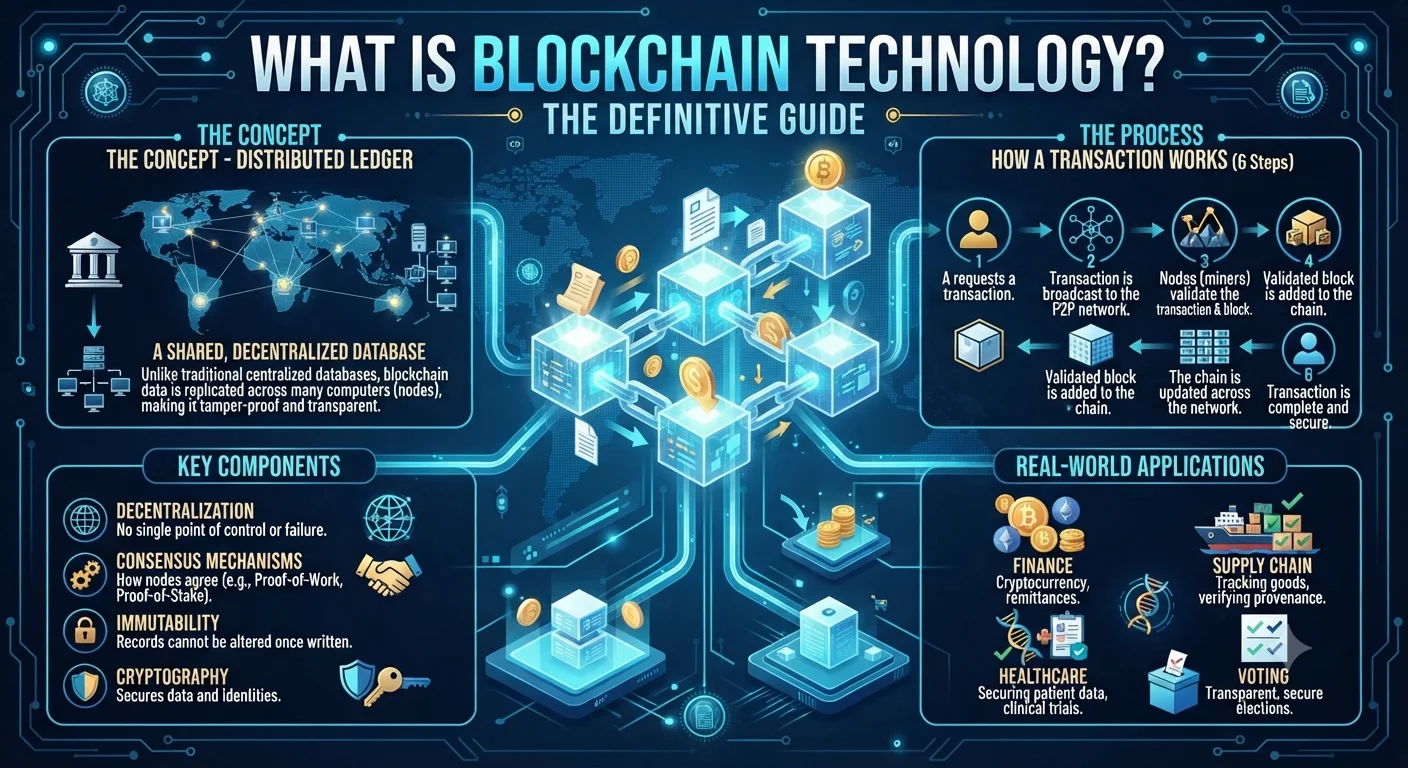
A blockchain is a type of database. But it is a database with three properties that make it fundamentally different from anything that came before it:
1. It is distributed. Instead of living on one company's server, a copy of the blockchain exists simultaneously on thousands — sometimes hundreds of thousands — of computers around the world. These computers are called nodes. No single entity owns or controls the database.
2. It is append-only. Data can only be added to a blockchain, never deleted or modified. Once a transaction is recorded, it is permanent. This is the source of the term "immutability."
3. It uses cryptographic linking. Each block of data contains a cryptographic fingerprint (called a hash) of the previous block. This chain of hashes means that altering any historical record would require recalculating every subsequent block — a computational task that becomes practically impossible at scale.
These three properties together create something that previously required a trusted third party to achieve: a shared record that everyone can trust, that no one controls, and that no one can secretly change.
How a Distributed Ledger Works
The term distributed ledger technology (DLT) is broader than blockchain — it refers to any database that is shared and synchronized across multiple locations. Blockchain is the most famous type of distributed ledger, but they are not synonymous.
Here is how information gets onto a blockchain, using Bitcoin as the example:
Step 1 — A transaction is initiated. Alice wants to send 0.5 BTC to Bob. She creates a transaction signed with her private cryptographic key, proving she authorized it.
Step 2 — The transaction is broadcast. The transaction is broadcast to the peer-to-peer network of nodes. Each node receives it and adds it to a pool of unconfirmed transactions.
Step 3 — Transactions are grouped into a block. Miners (on proof-of-work networks) or validators (on proof-of-stake networks) collect pending transactions and group them into a candidate block.
Step 4 — Consensus is reached. The network runs its consensus mechanism — in Bitcoin's case, proof-of-work mining — to determine which node gets to add the next block. The winning node broadcasts the completed block.
Step 5 — The block is added. Every node on the network independently verifies the new block and adds it to their copy of the blockchain. The transaction is now confirmed.
Step 6 — The chain grows. With each new block added (every ~10 minutes for Bitcoin), the confirmed transactions become increasingly difficult to reverse — because reversing them would require re-doing all the computational work for every block that followed.
This process requires no central authority, no bank, no clearing house, and no trusted intermediary of any kind. The rules are enforced by mathematics and cryptography, not by institutions.
Types of Blockchains: Public, Private, and Consortium
Not all blockchains are the same. They vary significantly in who can participate and who controls them.
Public Blockchains
A public blockchain is fully open. Anyone can read the data, participate in consensus, and submit transactions without permission. Bitcoin and Ethereum are public blockchains. They are the most decentralized and the most censorship-resistant, but also the slowest and most energy-intensive.
Key characteristic: permissionless — no one can be excluded.
Private Blockchains
A private blockchain is controlled by a single organization. Only approved participants can join and transact. These are essentially traditional databases with some blockchain-inspired features (append-only logs, cryptographic audit trails). Hyperledger Fabric, used in enterprise settings, is an example.
Key characteristic: permissioned — access is controlled by a central administrator. Critics argue these are simply databases with extra steps; proponents note the audit trail and tamper-evidence benefits.
Consortium Blockchains
A consortium blockchain sits between public and private. A group of organizations — say, a consortium of banks — jointly control the network. Participants are vetted but the control is shared across multiple entities rather than residing with one. R3 Corda and Quorum are examples used in financial services.
Key characteristic: partially decentralized — controlled by a known group rather than a single entity or the open public.
For the purposes of most cryptocurrency and DeFi discussion, "blockchain" means a public blockchain.
Real-World Blockchain Use Cases
The most obvious use case is digital currency — Bitcoin as a store of value and medium of exchange. But the technology's applications extend far beyond money.
Financial services and cross-border payments. Blockchain enables near-instant settlement of international transfers that currently take days through the traditional correspondent banking system. Ripple (XRP) and Stellar (XLM) specifically target this use case. In 2023, the Bank for International Settlements ran multiple pilot programs exploring blockchain-based settlement between central banks.
Recommended Articles
 BLOCKCHAIN WEB3
 BLOCKCHAIN WEB3
Supply chain tracking. Every step in a product's journey — from raw material to consumer — can be recorded on a blockchain, creating an immutable audit trail. Walmart has used blockchain to trace food safety issues in leafy greens from store shelf back to the specific farm within seconds, versus the days it previously took. IBM's Food Trust platform runs on Hyperledger Fabric.
Healthcare and medical records. Patient medical records are currently fragmented across hospitals, clinics, and pharmacies — often inaccessible when needed most. Blockchain-based medical record systems allow patients to own their data and grant access to any provider, while maintaining an immutable audit log of who accessed what and when.
Digital identity verification. Traditional identity documents are vulnerable to forgery and require physical presentation. Decentralized identity systems (DIDs) use blockchain to allow individuals to control verifiable credentials — proving their age, qualifications, or identity without revealing unnecessary personal data.
Smart contracts and automation. On programmable blockchains like Ethereum, code can be deployed directly onto the chain and executed automatically when conditions are met. An insurance policy that automatically pays out when flight delay data reaches a certain threshold, with no claims process, no human adjudicator, and no possibility of the insurer refusing to pay — this is the promise of smart contract automation.
Blockchain vs Traditional Databases
A common and legitimate question: if blockchain is just a database, why not use a regular database?
| Property | Traditional Database | Public Blockchain |
|---|---|---|
| Control | Single entity | No single controller |
| Trust | Requires trusting the operator | Trustless (rules enforced by code) |
| Transparency | Private by default | Public by default |
| Speed | Very fast | Slower |
| Cost | Low | Transaction fees apply |
| Immutability | Data can be edited/deleted | Data cannot be altered |
| Censorship resistance | Operator can restrict access | No one can be excluded |
The honest answer is: for most applications, a traditional database is better — faster, cheaper, and simpler. Blockchain makes sense specifically when the participants do not trust each other and do not want a single entity in control. When there is already a trusted central authority (a company, a government, a known consortium), the benefits of blockchain shrink considerably.
Layer 1 vs Layer 2 Blockchains
As blockchain networks grew in popularity, their limitations became apparent. Ethereum at peak demand in 2021 had gas fees exceeding $100 for simple transactions. This is the scalability problem.
Layer 1 refers to the base blockchain itself — Bitcoin, Ethereum, Solana, Avalanche. Layer 1 networks prioritize security and decentralization; speed and cost are the trade-off.
Layer 2 solutions are built on top of Layer 1 networks to handle transaction processing more efficiently, then settle the final state back to Layer 1 for security. Examples include the Lightning Network (Bitcoin payments), Polygon, Arbitrum, and Optimism (Ethereum scaling).
Layer 2 networks can process thousands of transactions per second at fractions of a cent, while inheriting the security guarantees of the underlying Layer 1. They are the most promising path to blockchain networks that can serve millions of everyday users without prohibitive fees.
Nodes and Consensus Mechanisms
A node is any computer that participates in a blockchain network by maintaining a copy of the ledger and validating transactions. Full nodes store the entire history of the blockchain; light nodes store only block headers and rely on full nodes for data.
A consensus mechanism is the ruleset by which nodes agree on the valid state of the blockchain — essentially, how they collectively decide which transactions are legitimate and which blocks are valid.
The two dominant mechanisms are:
Proof of Work (PoW): used by Bitcoin. Nodes compete to solve a mathematical puzzle; the winner adds the next block. Extremely energy-intensive but battle-tested over 15+ years.
Proof of Stake (PoS): used by Ethereum post-Merge, Solana, Cardano. Validators lock up cryptocurrency as collateral; they are selected to validate blocks proportionally to their stake. Far more energy-efficient, but introduces different trust assumptions around capital concentration.
Dozens of other mechanisms exist (Delegated PoS, Proof of History, Proof of Authority) each with different trade-offs between decentralization, speed, and security.
Conclusion
Blockchain is not magic, and it is not a cure for every problem. It is a specific tool — a distributed, immutable ledger secured by cryptography — that solves a specific problem: how to create shared records without a trusted central authority.
Where that problem exists — in open financial networks, in global supply chains, in cross-border payment systems, in digital ownership — blockchain offers genuinely transformative possibilities. Where that problem does not exist, traditional systems usually outperform it.
Understanding this distinction is the beginning of genuine blockchain literacy. From here, the natural progression is understanding the most important programmable blockchain — Ethereum — and the ecosystem of decentralized applications built on top of it.
Disclaimer: This article is for educational and informational purposes only. It does not constitute financial or investment advice. Always conduct your own research before making financial decisions.