Introduction
Every time a Bitcoin transaction is confirmed, somewhere in the world a computer or more likely a warehouse full of specialized machines burned electricity, performed trillions of calculations, and competed to solve a mathematical puzzle. The winner added a new block of transactions to the blockchain and earned a reward in freshly created Bitcoin.
This process is called crypto mining, and it is far more elegant and far more consequential than its name suggests.
Crypto mining is not just how new coins enter circulation. It is the mechanism that secures the most valuable decentralized financial network ever built. Without miners, Bitcoin does not exist. Understanding how mining works is essential whether you are an investor evaluating the asset, someone considering mining themselves, or simply a curious person trying to make sense of the headlines.
This guide explains everything from first principles, with no assumed technical knowledge.
How Crypto Mining Works
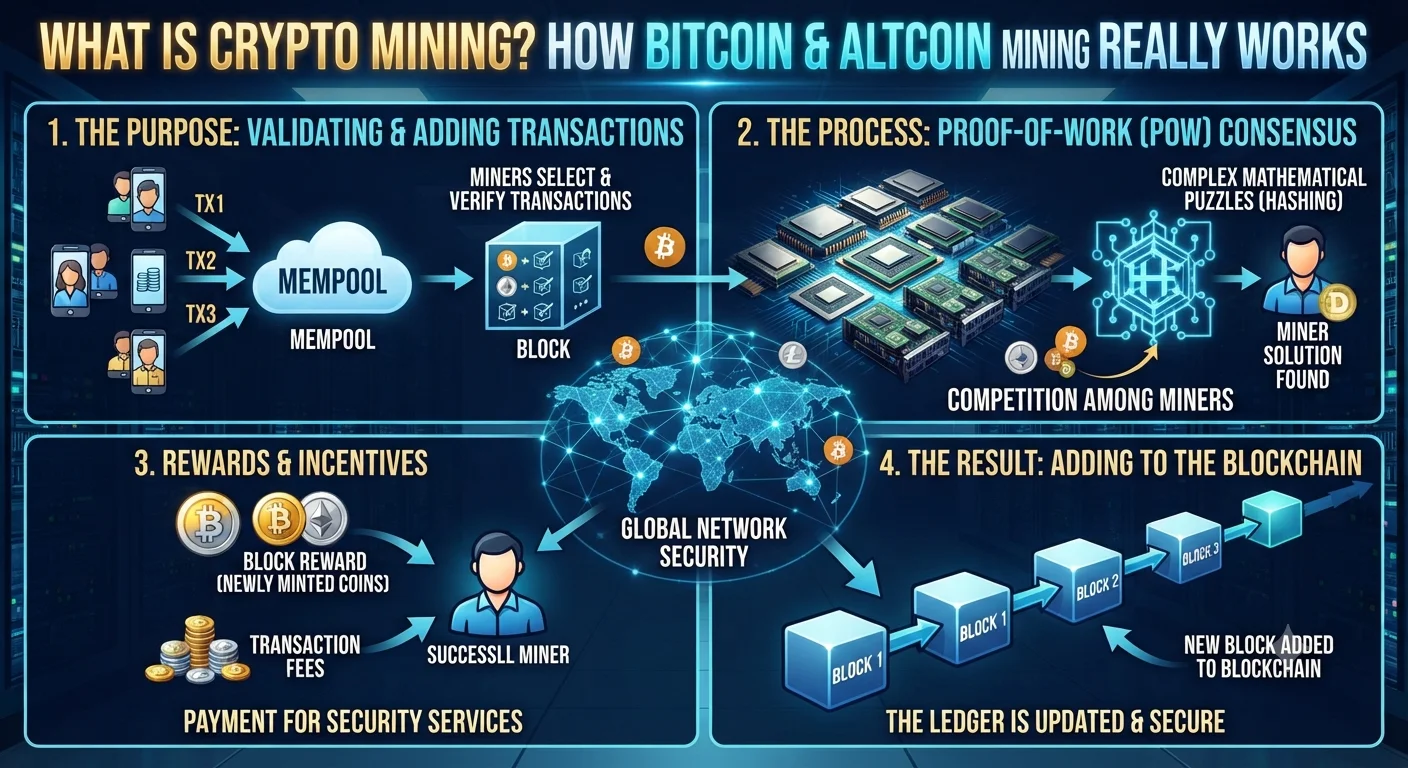
At its core, crypto mining is the process of validating transactions and adding them to a blockchain — a permanent, public record of all activity on a network.
Here is the step-by-step process for Bitcoin:
1. Transactions are broadcast. When someone sends Bitcoin, that transaction is broadcast to the Bitcoin network and enters a waiting area called the mempool (memory pool). Unconfirmed transactions sit here until a miner picks them up.
2. Miners gather transactions. Mining computers pull pending transactions from the mempool and bundle them together into a candidate block. They also add a special entry called the coinbase transaction — this is how new Bitcoin is created and awarded to the winning miner.
3. The puzzle begins. Each block must include a piece of data called a nonce (number used once). Miners compete to find a nonce that, when combined with all the other block data and run through a cryptographic function called SHA-256, produces an output (called a hash) that meets a specific target — it must be below a certain numerical value. This target is what makes the puzzle hard.
4. Trillions of attempts. SHA-256 hashing is fast but unpredictable — there is no way to calculate which nonce produces the right hash without just trying them. Mining hardware performs trillions of these attempts every second, which is why the measurement unit is terahashes per second (TH/s).
5. A winner is found. Eventually, one miner finds a valid nonce. They broadcast their completed block to the network. Other nodes verify it in milliseconds (verification is easy; finding the answer is hard) and add it to their copy of the blockchain.
6. The reward is issued. The winning miner receives a block reward — currently 3.125 BTC following the April 2024 halving — plus all the transaction fees included in the block. This is the only incentive a miner has, and it is denominated entirely in Bitcoin.
7. The process repeats. A new block starts every approximately 10 minutes. The Bitcoin protocol is designed to produce one block per 10 minutes on average, regardless of how much or how little computing power is pointed at the network.
Proof of Work vs Proof of Stake
Bitcoin uses a consensus mechanism called Proof of Work (PoW). The "work" is the energy-intensive computation described above. The logic is elegant: to add a fraudulent block to the chain, an attacker would need to redo all the work for that block and every block that followed it, faster than the rest of the honest network is adding new blocks. With Bitcoin's network now commanding an enormous hash rate, this is computationally — and economically — infeasible.
Proof of Stake (PoS) is an alternative approach used by Ethereum (since September 2022), Solana, Cardano, and many other networks. Instead of competing with computing power, validators lock up (stake) cryptocurrency as collateral. They are chosen to validate blocks in proportion to their stake. There is no mining involved. PoS uses a fraction of the energy of PoW and is increasingly popular — but it changes who has influence over the network (those with the most capital, rather than those with the most hardware).
For our purposes in this guide, mining refers to Proof of Work systems — Bitcoin being the most important and widely mined.
What is a Hash Rate?
Hash rate is the measure of how much computational power a mining device (or the entire network) is producing. It tells you how many hash calculations are being performed per second.
Common units:
| Unit | Full name | Calculations per second |
|---|---|---|
| KH/s | Kilohash | 1,000 |
| MH/s | Megahash | 1,000,000 |
| GH/s | Gigahash | 1,000,000,000 |
| TH/s | Terahash | 1,000,000,000,000 |
| PH/s | Petahash | 1,000,000,000,000,000 |
| EH/s | Exahash | 1,000,000,000,000,000,000 |
As of mid-2025, Bitcoin's global network hash rate has exceeded 700 EH/s — a figure that represents an incomprehensible amount of computing work being done every second.
A higher hash rate from your miner means a proportionally better chance of finding the next valid block. But because the network adjusts its difficulty regularly (more on this below), absolute hash rate matters less than your share of the total network hash rate.
Mining Pools vs Solo Mining
Here is the uncomfortable math of solo mining: with a single modern ASIC miner producing, say, 200 TH/s in a network doing 700 EH/s, your share of the network is approximately 0.0000000003%. On average, solo mining at that scale might produce one block reward every few thousand years.
This is where mining pools come in.
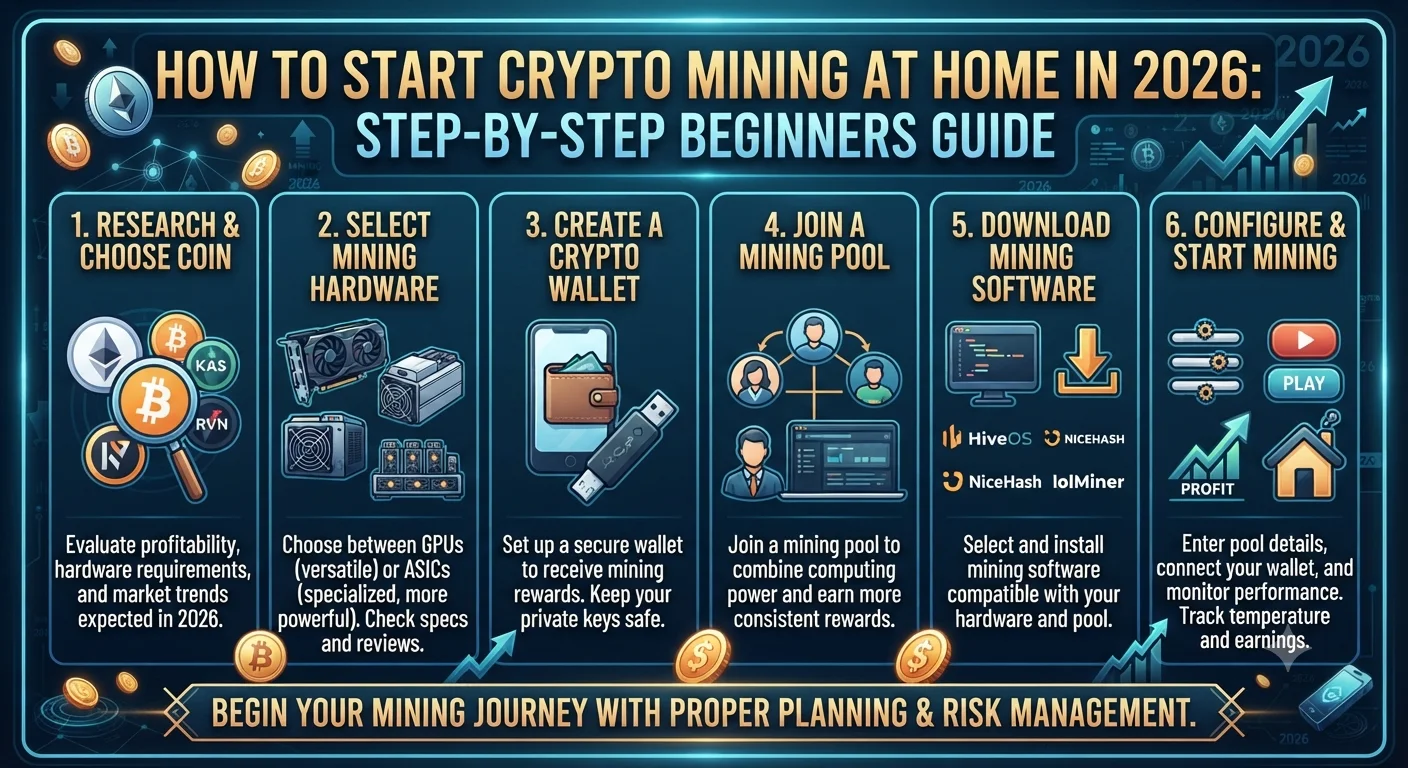
A mining pool is a group of miners who combine their hash rate and share block rewards proportionally. If the pool collectively finds a block, all members receive a payout based on the hash rate they contributed, minus a small pool fee (typically 1–3%).
Recommended Articles
 CRYPTO MINING
 CRYPTO MINING
 CRYPTO MINING
Mining pools dramatically smooth out the variance in mining income — instead of waiting potentially years for a solo reward, you receive smaller, regular payouts. For virtually all individual miners, joining a pool is the only rational approach.
The trade-off is that you do not control which transactions go into blocks — the pool operator does. This has implications for mining decentralization, which is an ongoing debate in the Bitcoin community.
Popular Bitcoin mining pools include: Foundry USA, AntPool, F2Pool, ViaBTC, and Binance Pool. Between them, these five pools regularly account for over 70% of Bitcoin's total hash rate.
ASIC vs GPU Mining
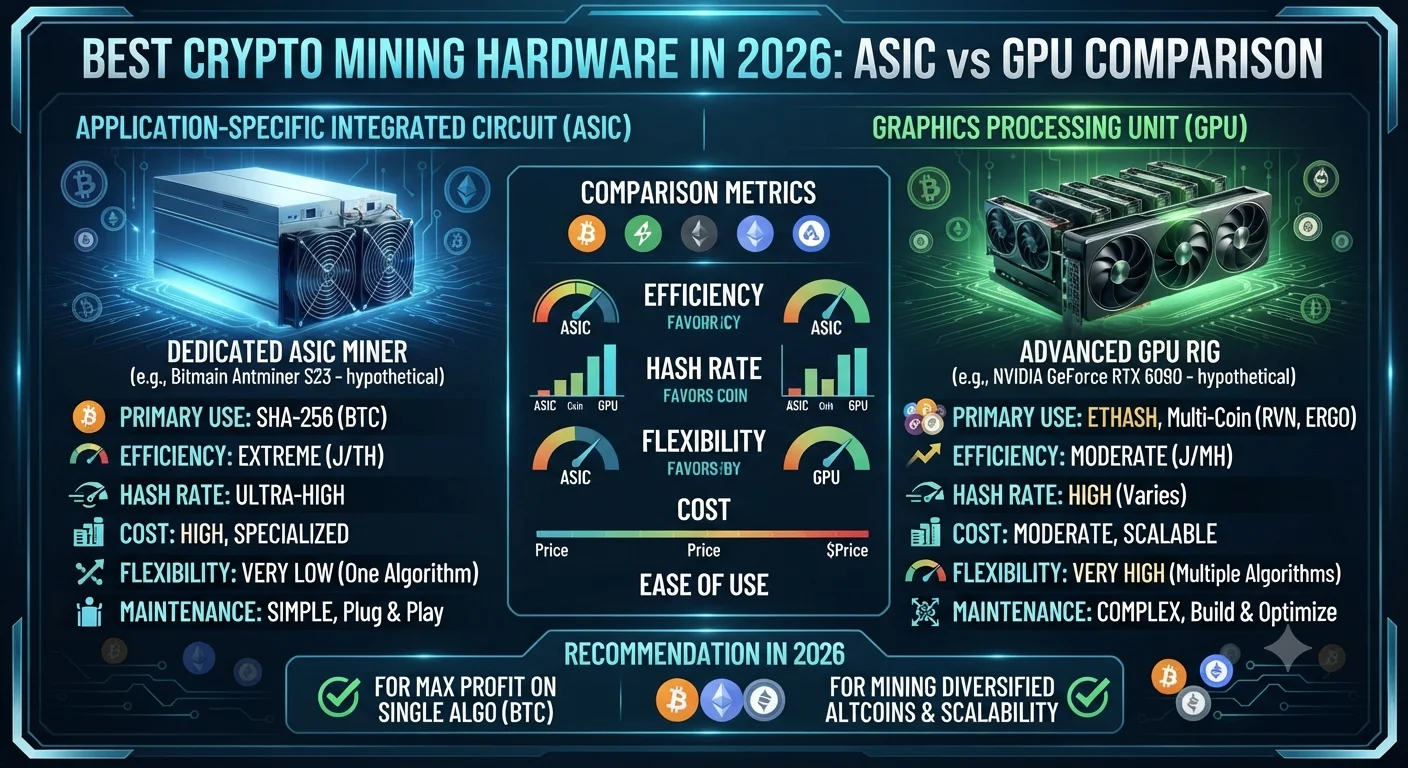
Not all mining hardware is created equal. There are two primary types of mining machines for proof-of-work cryptocurrencies:
ASIC Miners (Application-Specific Integrated Circuits) are purpose-built machines designed to do one thing only: mine a specific algorithm as efficiently as possible. The leading manufacturer, Bitmain, produces the Antminer series. ASICs are vastly more powerful and energy-efficient than any GPU for the algorithms they are designed for.
For Bitcoin (SHA-256 algorithm), ASICs are the only practical choice. The Bitmain Antminer S21 Pro, released in 2024, delivers approximately 234 TH/s at around 16 joules per terahash. A GPU cannot compete.
GPU Miners (Graphics Processing Units) are the graphics cards you might recognize from gaming computers — NVIDIA RTX and AMD Radeon series. GPUs are flexible: they can mine many different algorithms and switch between coins. They are the hardware of choice for altcoin mining, particularly for coins that use ASIC-resistant algorithms by design (like Monero's RandomX, which is optimized for CPUs, and Kaspa's KHeavyHash).
After Ethereum moved to Proof of Stake in September 2022, the GPU mining landscape changed significantly. Many miners switched to Ethereum Classic, Kaspa, Ravencoin, or other altcoins. Others sold their cards or repurposed them for AI compute rendering.
Is Crypto Mining Still Profitable in 2026?
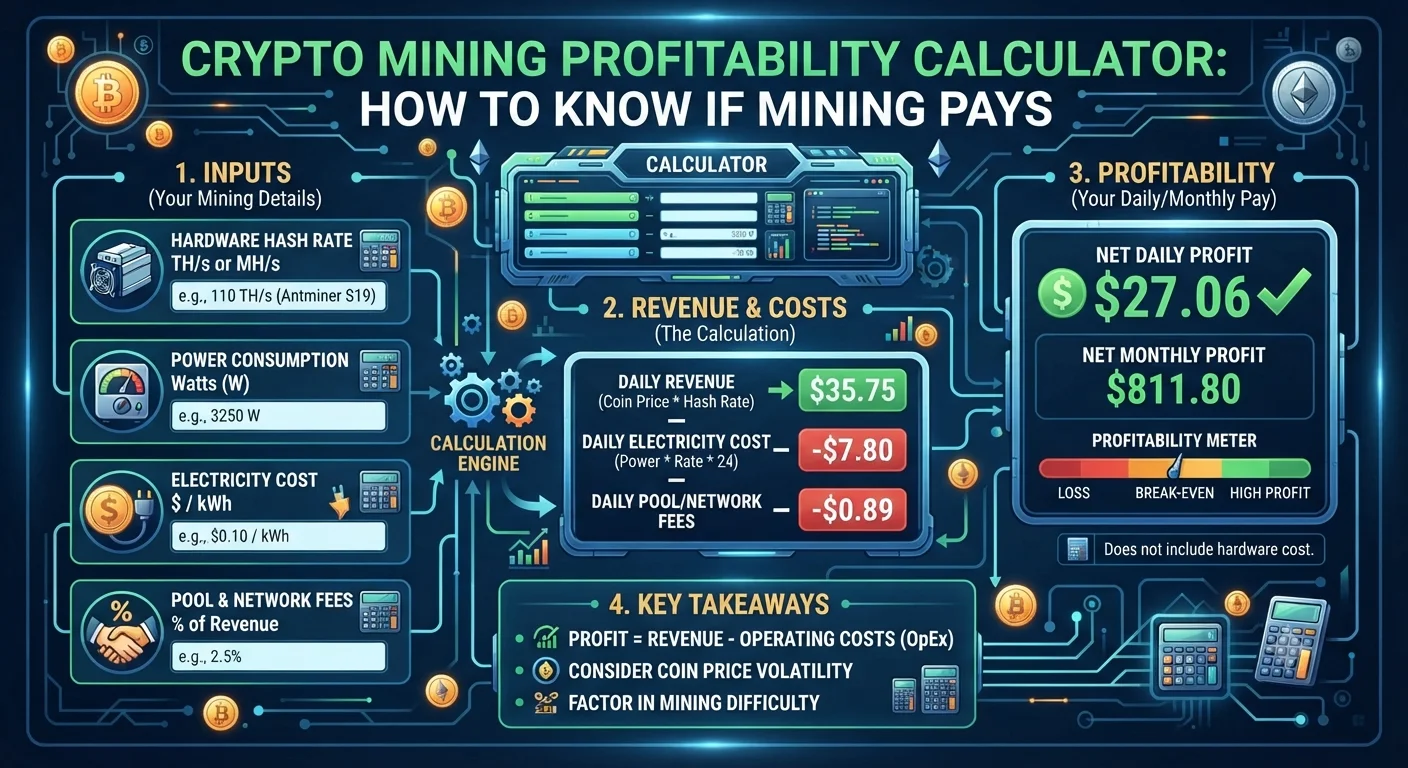
This is the question everyone asks, and the honest answer is: it depends on four variables.
1. Electricity cost. This is the single most important factor. Mining profitability is largely a competition in energy efficiency. Industrial miners with access to cheap hydroelectric or stranded gas power at $0.02–$0.04 per kWh can profit when home miners paying $0.12–$0.15 per kWh cannot. If your electricity cost is above $0.10/kWh, Bitcoin mining with current hardware is extremely difficult to make profitable.
2. Hardware efficiency. Older generation ASICs consume far more watts per terahash than current models. Running a 2019-era miner in 2026 is almost certainly unprofitable. The efficiency of your hardware determines your cost per Bitcoin produced.
3. Bitcoin price. The higher the Bitcoin price, the more each block reward is worth in fiat currency. Bitcoin's price volatility means mining profitability swings dramatically — operations that were deeply underwater in late 2022 became highly profitable after the 2023-2024 bull market.
4. Network difficulty. As more miners join the network, the mining difficulty increases and each individual miner earns proportionally less. Following the April 2024 halving, block rewards dropped from 6.25 BTC to 3.125 BTC — cutting revenue for every miner on the network overnight.
For home miners with average electricity rates, Bitcoin mining in 2026 is challenging. For industrial operations with access to low-cost power and the latest generation hardware, it can be highly profitable. Altcoin mining (particularly Kaspa and Litecoin/Dogecoin merge mining) remains more accessible for smaller operations.
Block Reward Halving: Why It Matters
Bitcoin was designed with a fixed, diminishing supply schedule. Every 210,000 blocks (approximately four years), the block reward is cut in half. This event is called the halving.
The history of halvings:
| Date | Block Height | Block Reward |
|---|---|---|
| January 2009 | Genesis block | 50 BTC |
| November 2012 | 210,000 | 25 BTC |
| July 2016 | 420,000 | 12.5 BTC |
| May 2020 | 630,000 | 6.25 BTC |
| April 2024 | 840,000 | 3.125 BTC |
| ~2028 | 1,050,000 | 1.5625 BTC |
The halving ensures that Bitcoin's total supply will never exceed 21 million coins. As block rewards diminish over time, transaction fees become an increasingly important component of miner revenue — a design assumption that remains one of the more debated aspects of Bitcoin's long-term economic model.
Conclusion
Crypto mining is the backbone of proof-of-work blockchain networks — the mechanism that secures transactions, issues new coins, and makes decentralization possible without a central authority. It is also a serious, capital-intensive industry that rewards those who can access cheap energy and efficient hardware.
Whether you are considering mining yourself or simply want to understand Bitcoin more deeply, the fundamentals covered here — hash rate, block rewards, mining pools, difficulty adjustments, and the ASIC vs GPU landscape — are the essential building blocks.
The next natural step is understanding the hardware options available in 2025 and how to calculate whether mining would actually be profitable for your specific situation.
Disclaimer: This article is for educational and informational purposes only. Cryptocurrency mining involves financial risk. The profitability figures mentioned are illustrative and subject to change based on market conditions. Always conduct thorough research before making any financial decision.