Introduction
Two of the most popular financial markets in the world are the forex market and the stock market. Both offer opportunities to grow your wealth — but they work very differently, attract different types of traders, and carry different levels of risk.
If you're a beginner trying to decide where to start, or an experienced trader curious about the other market, this guide breaks down every key difference between forex and stock trading in plain language.
By the end, you'll know exactly which market suits your goals, your schedule, and your risk tolerance.
What is Forex Trading?
- Introduction
- What is Forex Trading?
- What is Stock Trading?
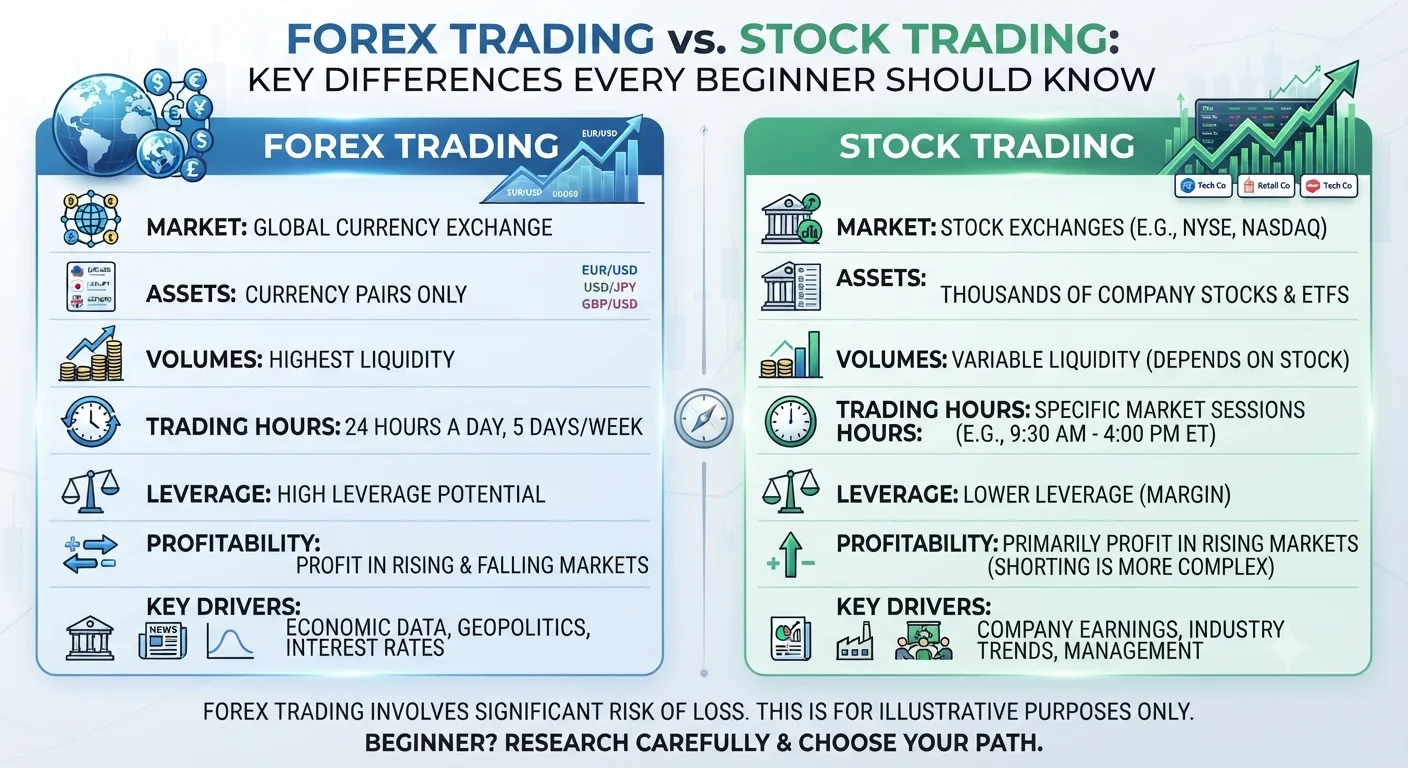
- Forex vs Stocks: The Key Differences at a Glance
- 1. Market Size and Liquidity
- 2. Trading Hours
- 3. Leverage
- 4. Number of Instruments to Trade
- 5. Transaction Costs
- 6. Volatility and Price Movement
- 7. Profiting in a Falling Market
- 8. Dividends and Ownership
- Which is Better for Beginners: Forex or Stocks?
- Can You Trade Both Forex and Stocks?
- Summary
- Frequently Asked Questions (FAQ)
Forex (foreign exchange) trading is the buying and selling of currency pairs — for example, buying the Euro and selling the US Dollar (EUR/USD) — with the goal of profiting from changes in exchange rates.
The forex market is the largest financial market in the world, with a daily trading volume exceeding $7.5 trillion according to the Bank for International Settlements (BIS) 2022 Triennial Survey. It is a decentralized, over-the-counter (OTC) market, meaning there is no single central exchange — trades happen directly between participants through a global network of banks, brokers, and institutions.
What is Stock Trading?
Stock trading involves buying and selling shares of ownership in publicly listed companies — for example, buying shares of Apple (AAPL) or Tesla (TSLA) on the New York Stock Exchange (NYSE) or Nasdaq.
When you own a stock, you own a small piece of that company. Your profit comes from two sources: an increase in the stock's price (capital gain) and dividend payments if the company distributes profits to shareholders.
Unlike forex, stock trading happens on regulated centralized exchanges with strict listing requirements and oversight by financial regulators such as the U.S. Securities and Exchange Commission (SEC).
Forex vs Stocks: The Key Differences at a Glance
| Factor | Forex Trading | Stock Trading |
|---|---|---|
| Market size | $7.5 trillion/day | ~$200–300 billion/day |
| Trading hours | 24 hours/day, 5 days/week | Exchange hours only (e.g., NYSE: 9:30am–4pm ET) |
| Number of instruments | ~80 major currency pairs | Thousands of stocks |
| Leverage available | Up to 1:500 (varies by broker) | Typically 1:2 to 1:4 (for margin accounts) |
| Transaction costs | Spread (no commission usually) | Commission + spread |
| Volatility | High (especially during news) | Moderate to high |
| Profit in falling market | Yes (short selling is simple) | Yes but more restricted |
| Dividends | No | Yes (on some stocks) |
| Regulation | Varies by country/broker | Highly regulated centrally |
| Best for | Short-term traders | Both short and long-term investors |
1. Market Size and Liquidity
The forex market dwarfs every other financial market on earth. With over $7.5 trillion traded every single day, it offers unmatched liquidity — the ability to enter and exit trades quickly at your desired price, even with large position sizes.
The global stock market, while massive in terms of total value (over $100 trillion in market capitalisation), sees much lower daily trading volumes — typically around $200–300 billion per day across all exchanges combined.
What this means for you: In forex, you'll almost never have trouble filling an order instantly. In stock trading, smaller or less popular stocks can have low liquidity, making it harder to buy or sell at the price you want.
2. Trading Hours
This is one of the biggest practical differences between the two markets.
Forex market hours: The forex market is open 24 hours a day, 5 days a week — from Sunday 5:00 PM EST (when the Sydney session opens) through Friday 5:00 PM EST (when the New York session closes). It operates across four major sessions: Sydney, Tokyo, London, and New York.
Stock market hours: Stock exchanges have fixed hours. The New York Stock Exchange (NYSE) and Nasdaq operate from 9:30 AM to 4:00 PM Eastern Time, Monday to Friday. Most other global exchanges have similar fixed windows.
| Session | Forex Open (EST) | Stock Exchange |
|---|---|---|
| Sydney | 5:00 PM | Australian Securities Exchange (ASX) |
| Tokyo | 7:00 PM | Tokyo Stock Exchange (TSE) |
| London | 3:00 AM | London Stock Exchange (LSE) |
| New York | 8:00 AM | NYSE / Nasdaq |
What this means for you: If you have a full-time job or prefer trading in the evening, forex gives you far more flexibility. Stock trading requires you to be available during specific exchange hours.
3. Leverage
As covered in our guide on What is Forex Leverage?, forex brokers commonly offer leverage ratios of 1:50, 1:100, or even 1:500 depending on the jurisdiction and broker.
Stock brokers, by contrast, offer much more conservative leverage. In most regulated markets, retail stock traders are limited to 1:2 or 1:4 leverage on margin accounts.
This means forex traders can control far larger positions relative to their capital — which amplifies both profits and losses significantly more than in stock trading.
What this means for you: Forex leverage is powerful but dangerous for beginners. Stock market leverage is much more conservative, making it somewhat safer for those just starting out.
4. Number of Instruments to Trade
In forex, you primarily trade currency pairs. There are around 8 major pairs, 12 minor pairs, and dozens of exotic pairs — giving you roughly 80 instruments in total. This actually makes it easier to focus and develop expertise.
In the stock market, there are thousands of stocks listed on exchanges worldwide. While this gives you more choice, it also makes research and selection much more challenging.
What this means for you: Forex has a narrower focus, which can make it easier to specialise. Stock trading requires broader research across many companies, sectors, and economic reports.
5. Transaction Costs
Forex costs: Most forex brokers make money through the spread — the difference between the buy price and the sell price. Many brokers charge zero direct commission. Spreads on major pairs like EUR/USD can be as low as 0.1 to 1 pip with reputable brokers.
Recommended Articles
 INVESTMENT BASICS
Stock costs: Stock brokers typically charge a commission per trade (though many online brokers now offer commission-free trading), plus a spread. Some also charge platform fees, custody fees, and inactivity fees.
For active, short-term traders, forex can be more cost-efficient because of its tight spreads and zero-commission structure.
6. Volatility and Price Movement
Both markets are volatile, but they respond to different drivers.
Forex price drivers:
- Central bank interest rate decisions (Fed, ECB, BOE)
- Inflation data (CPI, PPI)
- Employment reports (NFP, jobless claims)
- Geopolitical events and political instability
- Trade balances and GDP growth
Stock price drivers:
- Company earnings reports (quarterly results)
- Management changes and corporate news
- Industry trends and sector performance
- Broader economic conditions
- Mergers, acquisitions, and dividends
What this means for you: In forex, a single central bank announcement can move a currency pair by hundreds of pips in seconds. In stocks, a surprise earnings miss can cause a stock to drop 10–20% overnight. Both require robust risk management.
7. Profiting in a Falling Market
In both markets, you can profit when prices fall — but the mechanics differ.
In forex, short selling is completely natural and straightforward. When you sell EUR/USD, you are automatically selling the Euro and buying the Dollar — profiting if the Euro falls. There is no additional cost or restriction.
In stock trading, short selling requires you to borrow shares from your broker, sell them, and buy them back later at a lower price. This process can involve additional fees, borrowing costs, and regulatory restrictions.
What this means for you: Forex gives equal and easy access to both long and short trades. Stock short selling is more complicated and restricted, especially for retail traders.
8. Dividends and Ownership
When you buy stocks, you become a partial owner of the company. Some stocks pay dividends — regular cash payments from the company's profits distributed to shareholders. This provides an income stream even if the stock price doesn't move.
Forex trading offers no dividends or ownership. You are simply speculating on the change in value between two currencies. The only income-related concept in forex is the swap/rollover — and this is usually a cost, not income (though positive swaps are possible on some pairs).
What this means for you: If you want to build long-term passive income through dividends, stocks are more appropriate. If you want pure trading based on price movement, forex offers more flexibility.
Which is Better for Beginners: Forex or Stocks?
There is no single right answer — it depends on your goals, schedule, and personality.
Choose Forex if:
- You want to trade 24 hours a day and need schedule flexibility
- You prefer focusing on a small number of instruments
- You want high liquidity and tight spreads
- You're comfortable with fast-moving, news-driven markets
- You can dedicate time to learning technical and fundamental analysis
Choose Stocks if:
- You prefer investing in companies and sectors you understand
- You want the potential for long-term growth plus dividend income
- You are comfortable with fixed market hours
- You want a less leveraged, more regulated environment to start
- You prefer a longer investment horizon (months to years)
Can You Trade Both Forex and Stocks?
Absolutely. Many traders and investors participate in both markets, using different strategies for each. For example:
- Using stocks for long-term portfolio building and dividend income
- Using forex for short-term, active trading and hedging currency risk
Some brokers — such as IG, Saxo Bank, and Interactive Brokers — offer access to both forex and stocks on a single platform, making it easy to diversify across both markets.
Summary
Forex and stock trading both offer genuine opportunities to profit — but they are very different in how they work, when they're accessible, and what skills they require.
Key takeaways:
- Forex is a 24/5 market with higher leverage, tighter spreads, and fewer instruments to follow.
- Stock trading offers fixed hours, ownership rights, potential dividends, and a more regulated environment.
- Beginners often find stocks more beginner-friendly due to lower leverage and more familiar companies.
- Active traders often prefer forex for its flexibility and liquidity.
- The best choice depends on your personal goals, schedule, and risk tolerance.
Frequently Asked Questions (FAQ)
Is forex trading better than stock trading?
Neither is universally better. Forex suits active, short-term traders who want flexibility and high liquidity. Stock trading suits investors who prefer company ownership, dividends, and a longer time horizon. Your choice should depend on your personal goals and risk tolerance.
Can I make more money in forex than stocks?
Forex offers higher leverage, which means profit potential is higher — but so is the risk of loss. Many retail forex traders lose money due to improper use of leverage. Stocks have historically provided steady long-term returns, making them more reliable for wealth building over time.
Which market is open 24 hours — forex or stocks?
The forex market is open 24 hours a day, 5 days a week. Stock exchanges operate during fixed hours — for example, the NYSE is open from 9:30 AM to 4:00 PM Eastern Time, Monday to Friday.
Is it harder to learn forex or stocks?
Both require dedicated learning. Forex involves understanding currency pairs, macroeconomic events, and technical analysis. Stocks require understanding company financials, earnings reports, and sector dynamics. Most beginners find stocks slightly easier to start with due to lower leverage and more familiar brands.
How much money do I need to start forex vs stock trading?
Some forex brokers allow you to open an account with as little as $10–$50. Stock trading typically requires $200–$500 minimum, though fractional share platforms allow you to start with as little as $1. Always start with a demo account before risking real money.
What are the main risks of forex vs stock trading?
Forex's main risks are high leverage, rapid volatility during news events, and counterparty risk with unregulated brokers. Stocks carry risks such as company bankruptcy, market crashes, and lower liquidity in smaller stocks. Both require strict risk management to protect your capital.