Introduction
Every forex trader eventually discovers that price does not move randomly. At predictable times each month specific government agencies and central banks release economic data that the entire financial world watches simultaneously. In the seconds after these releases currency pairs can move 50 100 or even 200 pips in a direction determined by whether the data beat or missed market expectations.
The economic calendar is the tool that tells you when these events are scheduled what data is expected and how much impact the event has historically had on currency markets. Trading without checking the economic calendar is like sailing without checking the weather forecast. You can do it but you are accepting unnecessary risk from conditions you could have known about in advance.
This guide teaches you how to read an economic calendar use it to plan your trading and understand the key events that move the forex market most consistently.
What is an Economic Calendar?
- Introduction
- What is an Economic Calendar?
- High Impact Economic Events Explained
- Non Farm Payrolls (NFP)
- Consumer Price Index (CPI)
- FOMC Meetings
- European Central Bank (ECB) Policy Decisions
- Bank of England (BoE) Decisions
- Gross Domestic Product (GDP)
- Purchasing Managers Index (PMI)
- How to Use the Calendar to Avoid Volatility
- Best Free Economic Calendar Tools
- Trading Around Central Bank Decisions
- Conclusion
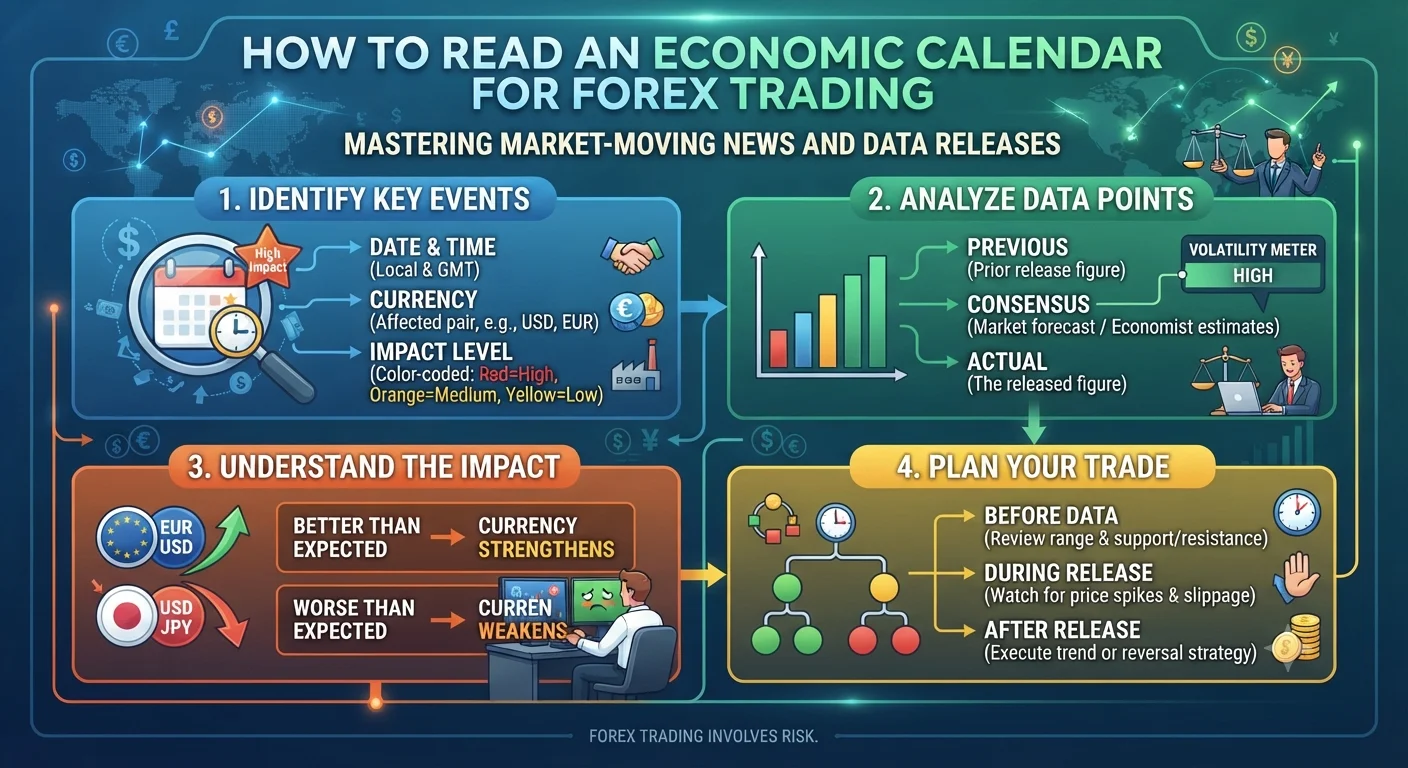
An economic calendar is a schedule of upcoming economic data releases central bank decisions government reports and geopolitical events that are likely to affect financial markets. For forex traders it is an essential planning tool used to identify when market volatility is expected and from which country's data the movement will originate.
A standard economic calendar entry includes several key fields.
Date and time tells you exactly when the event will occur. Times are typically shown in the trader's local time zone as well as GMT or EST.
Currency shows which currency pair or pairs the event is likely to affect. A US data release primarily affects USD pairs. A UK data release primarily affects GBP pairs.
Impact level indicates how much market movement the event has historically caused. Most calendars use a colour coding system or star rating. High impact events shown in red or marked with three stars are the ones that can cause significant immediate price movement. Medium impact events can cause moderate movement. Low impact events rarely cause significant price reaction.
Previous shows the most recent prior reading of the data point giving context for whether the economy is improving or deteriorating over time.
Forecast shows the consensus estimate from economists surveyed in advance of the release. This is the figure the market has already priced in. The actual release is compared against this forecast to determine whether it beat or missed expectations.
Actual is filled in after the data is released showing the real figure. The relationship between actual and forecast determines the initial market reaction.
High Impact Economic Events Explained
Not all calendar events are equal. Some are routine data points that barely move the market. Others are consistently among the most volatile moments in the entire forex trading calendar. These are the events every trader must understand.
Non Farm Payrolls (NFP)
Released on the first Friday of every month by the US Bureau of Labor Statistics the Non Farm Payrolls report measures the net change in employed persons in the United States excluding the farming sector. It is consistently the single most market moving scheduled event in forex.
NFP affects every USD currency pair. The report includes the headline jobs figure the unemployment rate and average hourly earnings data. Markets react most strongly to the headline payrolls number relative to the economist consensus forecast.
A significantly better than expected result typically strengthens USD as it implies a strong economy and reduces the likelihood of Federal Reserve interest rate cuts. A significantly worse than expected result typically weakens USD as it implies economic softness and increases the probability of rate cuts.
The magnitude of the beat or miss matters. A result that is 50,000 jobs above consensus causes a much larger price move than a result that is 10,000 jobs above consensus.
Consumer Price Index (CPI)
The Consumer Price Index measures the rate of change in prices paid by consumers for a basket of goods and services. It is the primary measure of inflation used by most developed country central banks and released monthly.
CPI is closely watched because central banks use it as the primary input for interest rate decisions. When CPI rises above target the central bank is expected to raise rates or keep them elevated which typically strengthens the currency. When CPI falls below target the central bank is expected to cut rates which typically weakens the currency.
CPI releases for the United States United Kingdom Eurozone Australia and Canada are all high impact events for their respective currency pairs.
FOMC Meetings
The Federal Open Market Committee is the body within the US Federal Reserve that sets interest rate policy. It meets eight times per year. These meetings are among the highest impact events in all financial markets not just forex.
What moves markets is not just the rate decision itself but the accompanying statement press conference with the Fed Chair and the quarterly projections known as the dot plot which shows where committee members expect rates to be over the next several years.
The dollar can move sharply in both directions within the same FOMC event as markets interpret the nuances of the statement language. Hawkish language suggesting rates will stay higher for longer typically strengthens USD. Dovish language suggesting cuts are coming typically weakens USD.
European Central Bank (ECB) Policy Decisions
The ECB sets interest rate policy for the 20 countries of the Eurozone and is the primary driver of EUR price action on meeting days. The ECB meets approximately every six weeks. Like FOMC meetings the entire package of rate decision statement and press conference matters not just the headline decision.
Recommended Articles
 MARKET NEWS
 MARKET NEWS
Bank of England (BoE) Decisions
The Bank of England meets approximately every six weeks to set UK monetary policy. GBP is highly sensitive to BoE rate decisions and particularly to the Monetary Policy Committee vote count which shows how many of the nine committee members voted for each rate option.
Gross Domestic Product (GDP)
GDP releases measure the total economic output of a country over a quarter. They confirm whether an economy is growing contracting or stagnant. Most major economies release preliminary flash and final GDP readings for each quarter with the flash reading causing the most movement as it is the first data point available.
Purchasing Managers Index (PMI)
PMI surveys measure business activity in the manufacturing and services sectors. A reading above 50 indicates expansion below 50 indicates contraction. PMI data is released monthly and provides early insight into economic direction before the fuller GDP data is available. Flash PMI releases are particularly watched for their ability to shift near term rate expectations.
How to Use the Calendar to Avoid Volatility
The economic calendar is not only a tool for trading news events. For many traders it is primarily a tool for avoiding unexpected volatility around data releases that they are not specifically trading.
If you are a swing trader holding a EUR/USD position for several days you should check whether an ECB meeting or US CPI release falls within your expected holding period. If it does you must decide whether to reduce your position size before the event or close the position entirely to avoid the risk of an adverse surprise.
Entering a trade in the hour before a high impact release on that currency pair is a common beginner mistake. The spread widens in the minutes before major events as liquidity providers reduce their exposure. Price can move sharply immediately on release and then reverse completely as the market processes the data. This combination of wide spreads and rapid reversals makes pre release trading particularly risky.
The practical routine for most traders is to check the economic calendar at the start of each trading day and identify all events rated high impact during that session. Avoid opening new positions in the affected currency pairs in the 30 minutes before these events. If you already hold positions consider whether to reduce size or move your stop loss closer to protect against a spike in the wrong direction.
Best Free Economic Calendar Tools
Several platforms offer high quality free economic calendars that are updated in real time.
Investing.com maintains what is widely considered the most comprehensive free forex economic calendar. It covers events from every major and emerging market economy filterable by impact level country and time period. The platform sends customisable alerts for events you want to monitor.
ForexFactory.com offers an extremely clean and popular economic calendar that has been the standard reference tool for retail forex traders for many years. Its colour coding system for impact levels is intuitive and the forum threads attached to each event allow you to see how other traders are interpreting upcoming data in advance.
TradingEconomics.com provides historical data alongside the calendar allowing you to see not just the upcoming events but the entire history of each data series. This historical context helps you understand whether current readings are elevated depressed or within normal ranges.
MetaTrader 5 includes a built in economic calendar directly in the platform which is convenient for traders who use MT5 as their primary trading environment.
Trading Around Central Bank Decisions
Trading directly around central bank decisions is one of the highest risk strategies in forex and is generally not recommended for beginner traders. The price action in the minutes before and after a major central bank decision is characterised by extreme volatility wide spreads and rapid reversals that make it difficult to execute orders at intended prices.
What experienced traders focus on instead is the medium term positioning that follows the interpretation of central bank communication. If the Federal Reserve's statement is interpreted as more hawkish than expected traders will look for opportunities to buy USD in the hours and days following the meeting rather than trying to trade the initial spike.
Understanding the likely direction of central bank policy over the coming months is the application of the economic calendar that provides the most consistent edge for traders using fundamental analysis.
Conclusion
The economic calendar is one of the most important tools in a forex trader's daily routine. It tells you when the highest risk moments of the trading day are approaching which currency pairs will be most affected and what the market is expecting from each data release.
Use it every morning before you begin your analysis. Check it before entering any trade that will be held through a high impact event. Understand the key events that drive your preferred currency pairs most consistently. And approach the actual trading around news events with caution until you have built sufficient experience to understand how different types of data surprises affect price in real time.
The calendar does not tell you which direction price will move. It tells you when the probability of large movement is highest. That knowledge alone is enormously valuable for risk management.
DISCLAIMER: This article is for educational and informational purposes only. It does not constitute financial or investment advice. Forex trading involves significant risk of loss. Always conduct your own research before trading.
RELATED ARTICLES: What Moves Forex and Crypto Prices? Global Market Drivers Explained What is Forex Trading? A Beginner's Complete Guide for 2025 Forex Risk Management: The Rules Professional Traders Follow