Introduction
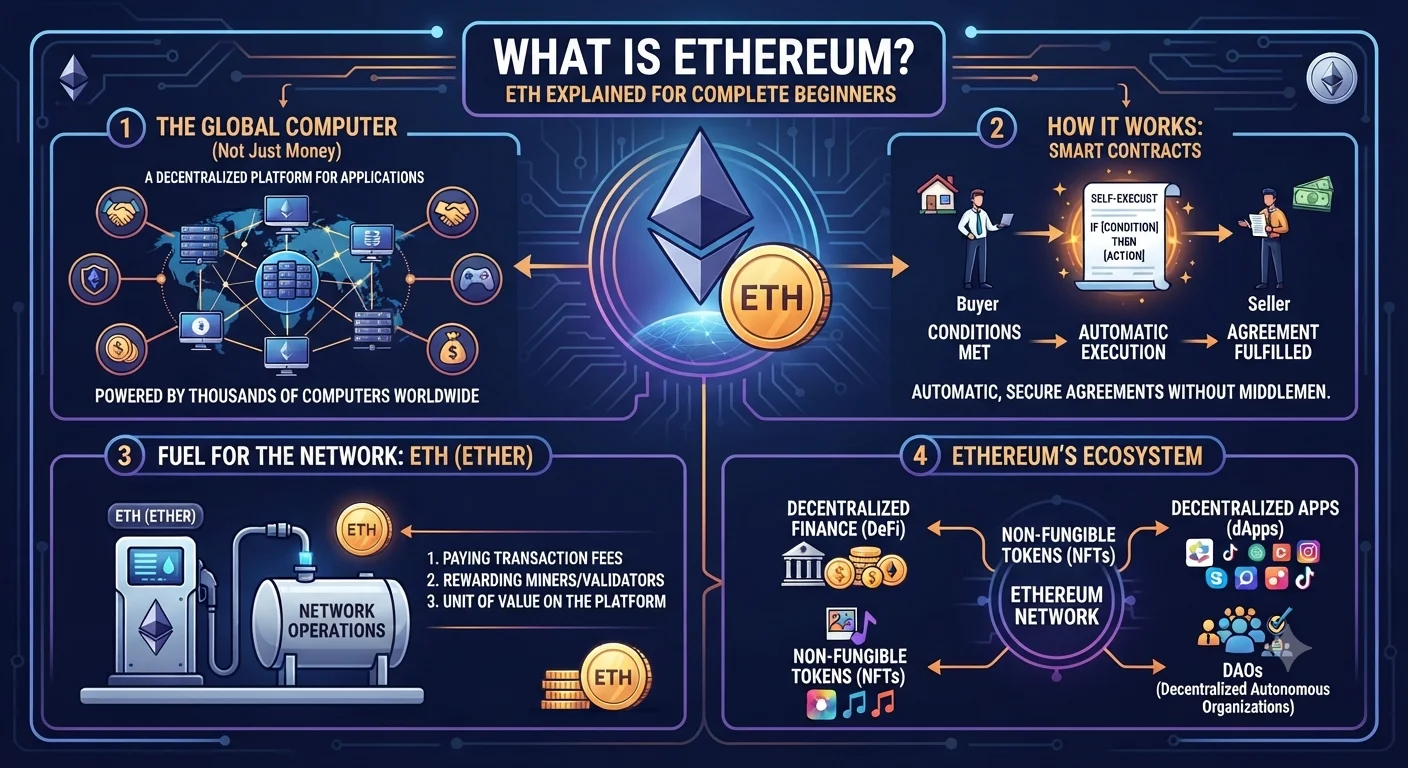
Bitcoin introduced the world to blockchain and decentralised digital money. Ethereum took the same foundational technology and asked a more ambitious question: what if a blockchain could run any programme automatically without any company or person in control?
The answer to that question is Ethereum. It is the second largest cryptocurrency by market capitalisation and by most measures the most actively developed blockchain in the world. It is the infrastructure layer beneath the majority of decentralised finance applications NFT marketplaces decentralised exchanges and Web3 projects that exist today.
Understanding Ethereum is essential for anyone trying to make sense of the crypto industry beyond Bitcoin. This guide explains what Ethereum is how it works why it matters and how it differs from every blockchain that came before it.
Ethereum vs Bitcoin: Key Differences
Bitcoin and Ethereum are both public blockchains. Both use distributed ledger technology. Both have native tokens that can be sent peer to peer without a bank or intermediary. Beyond these shared foundations they are fundamentally different systems built for different purposes.
Bitcoin was designed to do one thing and do it exceptionally well: be a decentralised store of value and medium of exchange. Its design is deliberately simple and conservative. Very little changes on the Bitcoin protocol and that stability is considered a feature. Bitcoin's scripting language is intentionally limited to reduce the attack surface and complexity of the network.
Ethereum was designed from the beginning to be a programmable blockchain. Its founder Vitalik Buterin released the Ethereum white paper in 2013 at the age of 19 describing a platform that could execute arbitrary programmes through smart contracts. Where Bitcoin asks what is the balance of this address Ethereum asks what are the rules this code specifies and has the condition been met to execute them?
The practical consequences of this difference are significant. Bitcoin's blockchain contains primarily financial transaction data. Ethereum's blockchain contains transaction data plus the entire codebase and state data of thousands of running applications. This makes Ethereum more complex more flexible and more demanding in terms of storage and computation.
The supply model also differs fundamentally. Bitcoin has a hard cap of 21 million coins. Ethereum has no fixed supply cap though its post Merge monetary policy has made ETH effectively deflationary in periods of high network usage through a fee burning mechanism introduced in August 2021.
What Are Smart Contracts?
Smart contracts are the defining feature of Ethereum that distinguishes it from all previous blockchain systems. A smart contract is a programme that lives on the Ethereum blockchain and executes automatically when predetermined conditions are met.
The word contract can be misleading. A smart contract is not a legal document. It is code. Its conditions are written in a programming language called Solidity and once deployed to the Ethereum blockchain the code runs exactly as written with no possibility of modification censorship or interference from any external party including the developers who wrote it.
A simple example illustrates the concept. Imagine two parties want to bet on the outcome of a football match. With a traditional agreement trust is required that both parties will pay if they lose. With a smart contract both parties deposit their wager amount into the contract before the match. The contract is coded to release the funds to the winner automatically when a trusted external data source called an oracle reports the match result. Neither party can refuse to pay because the funds are already held by the contract and the release is automatic and irreversible.
This trustless automatic execution is what makes smart contracts powerful. They remove the need for intermediaries in any situation where an outcome can be expressed in code and the relevant inputs can be provided reliably.
Smart contracts are the building blocks of decentralised applications. DeFi lending protocols use them to issue loans and manage collateral automatically. Decentralised exchanges use them to execute trades between users without a central order book. NFT contracts use them to define ownership transfer rules and royalty payments.
The Ethereum Virtual Machine (EVM)
The Ethereum Virtual Machine is the runtime environment in which all Ethereum smart contracts execute. It is a sandboxed virtual computer that runs identically on every node in the Ethereum network simultaneously ensuring that all nodes agree on the result of every smart contract execution.
The EVM is described as Turing complete meaning it can theoretically compute anything that any other computer can compute given sufficient resources. This is the source of Ethereum's flexibility as a platform for arbitrary applications.
Every operation performed by the EVM costs a specific amount of computational resources measured in units called gas. This prevents infinite loops that would freeze the network and creates a market for computational resources on the blockchain.
The EVM's design has been enormously influential. Dozens of other blockchains including Polygon Avalanche and BNB Chain have built their own EVM compatible environments meaning that smart contracts written for Ethereum can be deployed on these networks with little or no modification. This EVM compatibility has made Ethereum the de facto standard for smart contract development and has created a vast ecosystem of developers tools and infrastructure that all follow the same technical conventions.
ETH as a Currency and Gas Fee Token
Ether (ETH) is the native token of the Ethereum network. It serves two distinct purposes.
First it functions as a currency. ETH can be transferred between addresses stored in wallets bought and sold on exchanges and used as a medium of exchange for goods and services where accepted.
Recommended Articles
 BLOCKCHAIN WEB3
 BLOCKCHAIN WEB3
Second and more uniquely ETH is the resource token required to pay for computation on the Ethereum network. Every transaction and every smart contract execution requires gas and gas must be paid in ETH. You cannot use a different token to pay for Ethereum network fees. This creates structural demand for ETH from everyone who wants to use the network regardless of whether they are interested in ETH as an investment asset.
Since August 2021 when the EIP-1559 upgrade was implemented a portion of the gas fee paid on every transaction is permanently destroyed or burned rather than given to validators. This burning mechanism reduces the circulating supply of ETH over time. During periods of high network activity where many transactions are being processed the amount of ETH burned can exceed the amount of new ETH issued through staking rewards making ETH deflationary in net supply terms.
This supply mechanic is sometimes referred to as the triple halving because it creates a supply dynamic that advocates compare to Bitcoin's halving effect but implemented continuously through fee burning rather than in scheduled step changes.
Ethereum's Transition to Proof of Stake
On September 15 2022 Ethereum completed one of the most technically complex upgrades ever executed on a live blockchain network. Known as the Merge it transitioned Ethereum from a Proof of Work consensus mechanism to Proof of Stake.
Under Proof of Work Ethereum miners used specialised hardware to compete for block rewards in the same way Bitcoin miners do. This required enormous amounts of electricity. The Ethereum Foundation estimated that this transition reduced Ethereum's energy consumption by approximately 99.95%.
Under Proof of Stake block validators are chosen based on the amount of ETH they have deposited as collateral called staking rather than based on computational work. To become an independent validator on the Ethereum network 32 ETH must be deposited to the staking contract. Those who do not have 32 ETH can participate in liquid staking protocols or through staking services offered by exchanges.
Validators who behave honestly receive staking rewards in ETH. Validators who attempt to act dishonestly or who are offline excessively risk having a portion of their staked ETH destroyed through a mechanism called slashing.
The Merge eliminated GPU and ASIC mining on Ethereum entirely. The hardware that had been used to mine ETH became either repurposed for other proof of work coins or sold on the second hand market.
The Ethereum Ecosystem: DeFi NFTs and Beyond
Ethereum's programmability has made it the foundation of a vast ecosystem of applications. Understanding this ecosystem is important for grasping why Ethereum has the network value it does.
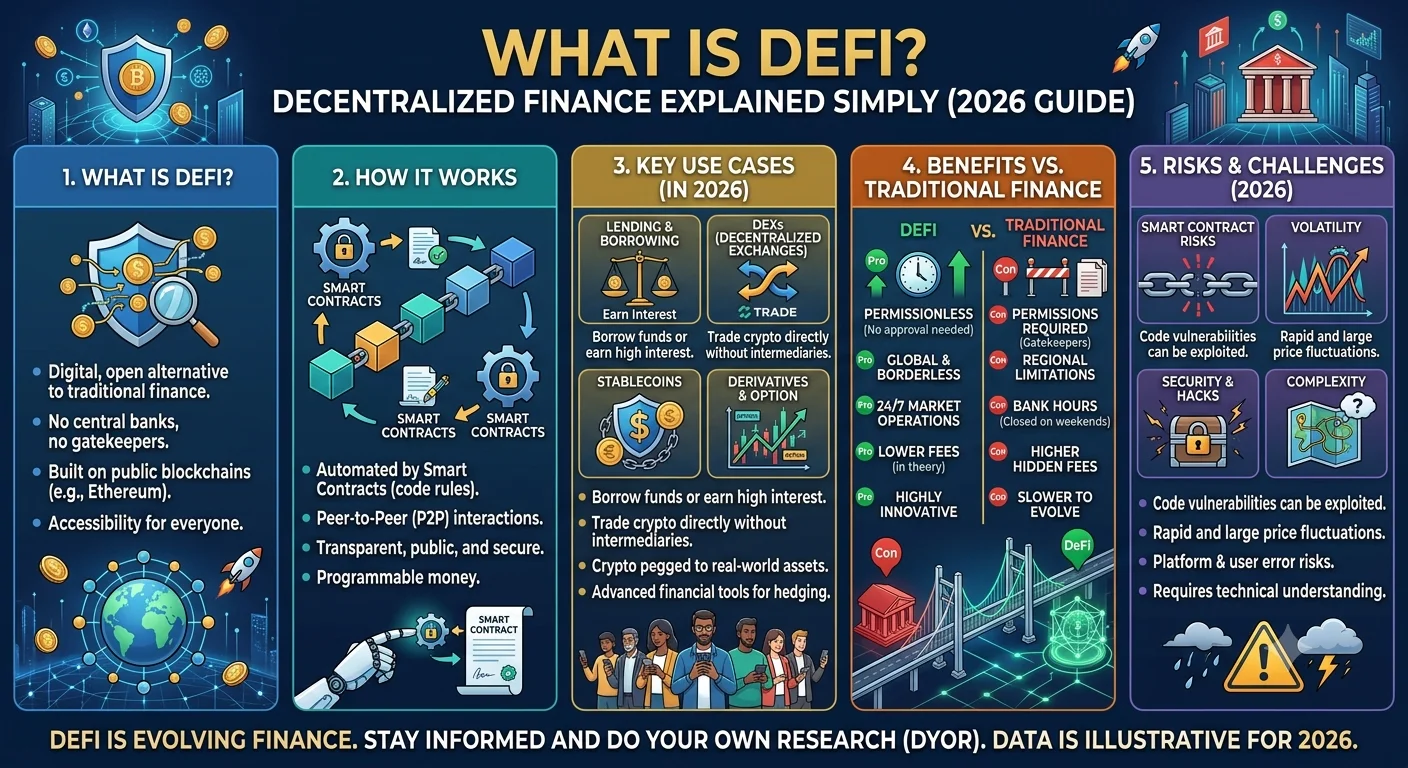
Decentralised finance represents the largest category by total value locked. Protocols like Uniswap Aave Compound and MakerDAO are built entirely on Ethereum smart contracts. They allow users to trade assets borrow against collateral lend for yield and create decentralised stablecoins without banks or financial intermediaries. As of 2025 the Ethereum ecosystem accounts for the majority of all value in the DeFi sector across all blockchains.
Non fungible tokens reached mainstream attention through Ethereum in 2021. The ERC-721 token standard which defines how unique non fungible tokens are created and transferred on Ethereum became the foundation for digital art collectibles gaming items and tokenised real world assets.
Layer 2 scaling networks including Arbitrum Optimism and Polygon zkEVM process transactions faster and at lower cost than the Ethereum base layer while settling to Ethereum for security. These networks have significantly expanded what is economically practical to build on top of the Ethereum ecosystem.
Ethereum's Challenges and Criticisms
Ethereum is not without its problems. High gas fees during periods of peak demand have been a persistent challenge. When network usage is high gas prices can rise to levels that make small transactions economically unviable. The growth of Layer 2 networks addresses this but also fragments the user experience across multiple chains.
Centralisation concerns exist around the staking validator set. A significant proportion of staked ETH is held through large liquid staking providers particularly Lido Finance. Critics argue this creates concentration risk in what should be a decentralised validator network.
Regulatory uncertainty continues to hang over the ETH token itself. The SEC in the United States has at various times suggested that ETH's proof of stake mechanism might make it a security under US law which would have significant implications for the asset's legal treatment in the world's largest financial market.
Conclusion
Ethereum is not simply a cryptocurrency. It is a programmable blockchain platform that serves as the infrastructure layer for a large and growing ecosystem of decentralised applications. Its native token ETH is both a currency and the fuel that powers every computation on the network.
Understanding Ethereum means understanding smart contracts the EVM gas mechanics the shift to Proof of Stake and the layer 2 scaling solutions being built on top of it. These components together explain why Ethereum has the developer adoption institutional interest and network effects that make it the second most important blockchain in the world.
For anyone building investing or learning in the crypto space Ethereum is not optional knowledge. It is foundational.
DISCLAIMER: This article is for educational and informational purposes only. It does not constitute financial or investment advice. Cryptocurrency investments are highly volatile and speculative. Always conduct your own research before making any financial decision.
RELATED ARTICLES: What is Blockchain Technology? The Definitive Guide What is DeFi? Decentralised Finance Explained Simply Layer 2 Blockchain Solutions: Scaling Ethereum Explained