Introduction
Welcome to TopMiningFX's weekly forex market analysis. Every Monday, we break down the key price levels, market structure, and upcoming economic events for the major currency pairs so you can plan your trading week with clarity.
This week we are covering: EUR/USD, GBP/USD, and USD/JPY — the three most traded currency pairs in the world, accounting for over 50% of all daily forex volume according to the Bank for International Settlements (BIS).
Economic Calendar Highlights: Week of July 14–18, 2026
- Introduction
- Economic Calendar Highlights: Week of July 14–18, 2026
- EUR/USD Analysis — July 14, 2026
- Market Overview
- Key Levels to Watch
- Trading Bias This Week
- Potential Scenarios
- GBP/USD Analysis — July 14, 2026
- Market Overview
- Key Levels to Watch
- Trading Bias This Week
- Potential Scenarios
- USD/JPY Analysis — July 14, 2026
- Market Overview
- Key Levels to Watch
- Trading Bias This Week
- Potential Scenarios
- Week in Review: What Happened Last Week
- Trading Tips for This Week
- Summary
- Frequently Asked Questions (FAQ)
Before diving into the charts, here are the highest-impact economic events scheduled this week that every forex trader should have on their radar:
| Day | Event | Currency | Expected Impact |
|---|---|---|---|
| Monday | US Empire State Manufacturing | USD | Medium |
| Tuesday | UK Employment / Claimant Count | GBP | High |
| Tuesday | US Retail Sales (MoM) | USD | High |
| Wednesday | UK CPI Inflation | GBP | Very High |
| Wednesday | US Federal Reserve Beige Book | USD | Medium |
| Thursday | ECB Interest Rate Decision | EUR | Very High |
| Thursday | US Initial Jobless Claims | USD | High |
| Friday | UK Retail Sales | GBP | High |
| Friday | US Michigan Consumer Sentiment | USD | Medium |
Key event of the week: ECB Interest Rate Decision (Thursday) The European Central Bank's rate decision is the single most important event for EUR pairs this week. Any surprise deviation from market expectations — whether a hold, cut, or hawkish commentary — can cause EUR/USD to move 100+ pips rapidly. Traders should be cautious holding EUR positions into Thursday's announcement without a risk-reducing stop-loss in place.
EUR/USD Analysis — July 14, 2026
Market Overview
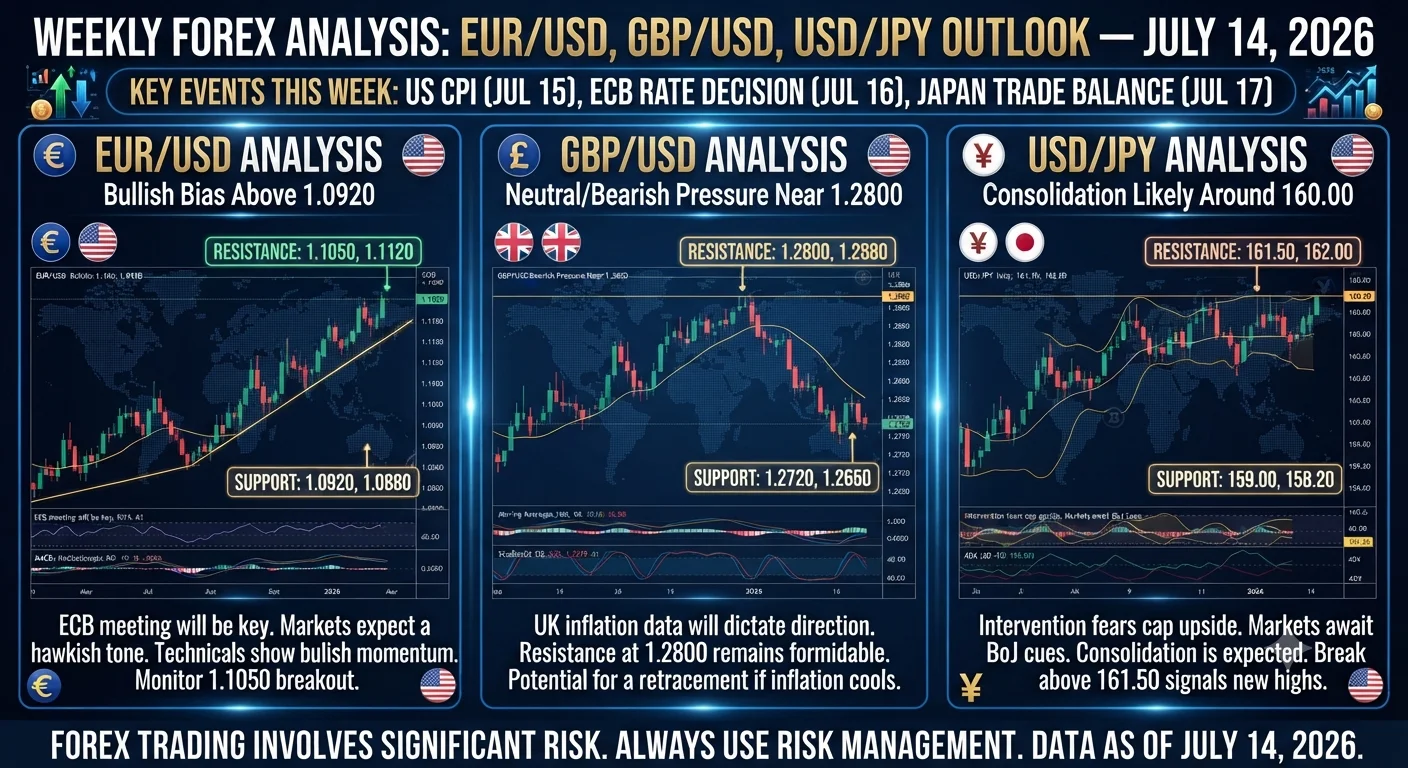
The EUR/USD pair has been trading in a broadly consolidating range in recent weeks, with the pair oscillating between key support around the 1.0800–1.0850 zone and resistance in the 1.1000–1.1050 area.
The broader trend on the Weekly chart remains cautiously bullish for the Euro, supported by the gradual stabilisation of Eurozone inflation and resilient PMI data out of Germany and France. However, the US Dollar has shown periodic strength on the back of robust jobs data and the Federal Reserve's continued cautious stance on rate cuts.
Key Levels to Watch
| Level | Type | Significance |
|---|---|---|
| 1.1050 | Resistance | Multi-week high, previous rejection zone |
| 1.0960 | Resistance | Intraweek resistance, 50 EMA on Daily |
| 1.0880 | Support | Recent consolidation base |
| 1.0820 | Support | Strong demand zone, multiple bounces |
| 1.0750 | Support | Major support, 200 EMA on Daily |
Trading Bias This Week
Neutral to Slightly Bullish — The pair needs a confirmed close above 1.0960 on the Daily chart to attract momentum buyers. Below 1.0880, the bias shifts neutral to bearish.
Watch: ECB rate decision Thursday. A hawkish ECB tone (suggesting fewer cuts ahead) would likely push EUR/USD toward 1.1000+. A dovish tone or surprise cut would pressure the pair toward 1.0820 support.
Potential Scenarios
- Bullish scenario: Price holds above 1.0880, ECB delivers a hold with hawkish forward guidance → target 1.1000–1.1050
- Bearish scenario: US retail sales beat expectations significantly, ECB tone is dovish → price breaks below 1.0820, targeting 1.0750
GBP/USD Analysis — July 14, 2026
Market Overview
The British Pound has been one of the stronger G10 currencies in recent months, underpinned by the Bank of England's (BoE) relatively hawkish stance compared to the Federal Reserve. GBP/USD has been trading above its 200-day moving average, a broadly positive technical signal.
The pair has recently found support around the 1.2700–1.2750 area and has been attempting a recovery toward the 1.2900 level.
Key Levels to Watch
| Level | Type | Significance |
|---|---|---|
| 1.3000 | Resistance | Psychological round number, multi-month high |
| 1.2880 | Resistance | 50 EMA on Daily chart |
| 1.2750 | Support | Key demand zone, recent swing low |
| 1.2650 | Support | Major support level |
| 1.2500 | Support | Long-term support, 200 EMA on Weekly |
Trading Bias This Week
Cautiously Bullish — GBP/USD structure remains constructive above 1.2750. However, this week is data-heavy for GBP, with UK employment data Tuesday and UK CPI Wednesday both capable of sharp moves.
Watch: UK CPI Wednesday. If UK inflation comes in hotter than expected, it reduces BoE rate cut expectations and strengthens the Pound — potentially pushing GBP/USD toward 1.2880–1.3000. A soft CPI print could trigger a move back to 1.2650.
Recommended Articles
 MARKET NEWS
 MARKET NEWS
Potential Scenarios
- Bullish scenario: UK CPI beats → BoE hold narrative strengthens → GBP/USD pushes toward 1.2880–1.3000
- Bearish scenario: UK employment weakens + CPI misses → BoE cut bets rise → GBP/USD drops toward 1.2650
USD/JPY Analysis — July 14, 2026
Market Overview
USD/JPY continues to be one of the most closely watched pairs in 2026, with the Bank of Japan's (BoJ) gradual monetary policy normalisation — including multiple rate hikes from the previous ultra-loose era — creating a new dynamic for the pair.
The pair has come off its extreme highs above 160 seen in 2024 and is now trading in a more moderate range as Japanese interest rates rise and the BoJ becomes more active in the market.
Key Levels to Watch
| Level | Type | Significance |
|---|---|---|
| 145.00 | Resistance | Psychological level, prior intervention zone |
| 143.50 | Resistance | 50 EMA on Daily |
| 141.80 | Support | Recent consolidation floor |
| 140.00 | Support | Psychological level, strong demand area |
| 138.50 | Support | Major swing low support |
Trading Bias This Week
Neutral — USD/JPY direction depends heavily on this week's US economic data. Strong US retail sales and jobless claims data would support the Dollar and push USD/JPY higher. Any BoJ commentary suggesting further rate hikes would strengthen the Yen and push the pair lower.
Potential Scenarios
- Bullish scenario: Strong US data + no BoJ hawkish surprise → USD/JPY recovers toward 143.50–145.00
- Bearish scenario: US data disappoints + BoJ signals further tightening → USD/JPY drops toward 140.00
Week in Review: What Happened Last Week
Last week, the Dollar experienced broad softness following weaker-than-expected US producer price data, which rekindled speculation about Federal Reserve rate cuts in Q3 2026. EUR/USD bounced from the 1.0820 support zone, GBP/USD held its 1.2750 demand area, and USD/JPY came under pressure as the Yen attracted safe-haven demand amid global risk-off sentiment.
Trading Tips for This Week
- Avoid trading EUR pairs in the 2 hours before and after the ECB decision on Thursday unless you have specific news-trading experience
- Monitor the US retail sales data on Tuesday — this will set the tone for USD direction for the first half of the week
- Use reduced position sizes on GBP pairs around Tuesday and Wednesday news due to expected high volatility
- Keep a watch on gold (XAU/USD) — gold's direction often inversely correlates with the Dollar and can confirm or contradict Dollar setups
- Check the economic calendar daily at Investing.com or Forex Factory for any last-minute data releases or central bank speeches
Summary
This is a high-impact week for forex traders, dominated by the ECB interest rate decision on Thursday and key UK data releases Tuesday and Wednesday.
- EUR/USD: Neutral to bullish above 1.0880. ECB decision is the week's make-or-break event for this pair.
- GBP/USD: Cautiously bullish above 1.2750. UK CPI on Wednesday is the key data point.
- USD/JPY: Neutral. Torn between US data strength and growing BoJ hawkishness.
Stay disciplined, manage your risk, and do not overtrade around major news events. We will publish a fresh weekly analysis every Monday.
Missed last week? Explore our Swing Trading Forex Strategy Guide to learn how to build trade setups around these key levels.
Frequently Asked Questions (FAQ)
What is weekly forex analysis?
Weekly forex analysis is a structured review of major currency pairs published at the start of each trading week. It covers key price levels, market structure, upcoming economic events, and trading bias to help traders plan their week with context and clarity.
Which currency pairs should beginners follow each week?
Beginners should focus on the three most liquid pairs: EUR/USD, GBP/USD, and USD/JPY. These pairs have the tightest spreads, the most reliable technical setups, and the greatest volume of market research and analysis available.
How does the ECB interest rate decision affect EUR/USD?
The ECB sets the interest rate for the Eurozone. When the ECB raises rates, the Euro typically strengthens because higher rates attract investment. When it cuts rates or signals dovish policy, the Euro weakens. The rate decision and press conference can cause EUR/USD to move 100–200 pips rapidly.
What is the best time to trade EUR/USD each week?
EUR/USD sees its highest volume and liquidity during the overlap of the London and New York sessions — typically between 1:00 PM and 5:00 PM GMT. Tuesday and Wednesday tend to offer the cleanest technical setups, while Thursday (with ECB/FOMC) can be volatile and unpredictable.