Introduction
If you have read anything about forex trading you have seen the word pip used constantly. Traders talk about making 50 pips on a trade or risking 30 pips to a stop loss. Brokers advertise spreads of 1.2 pips or 0.8 pips. News headlines describe currency moves in terms of pips gained or lost in a session.
Understanding what a pip is and how to calculate its value is not optional knowledge for a forex trader. It is the foundation of every profit and loss calculation you will ever make. Without it you cannot size your positions correctly you cannot set a meaningful stop loss and you cannot calculate whether a trade offers acceptable risk to reward.
This guide explains pips completely from definition to calculation to real trade examples.
What Exactly is a Pip?
- Introduction
- What Exactly is a Pip?
- The Japanese Yen Exception
- Pipettes and Fractional Pips
- How to Calculate Pip Value
- Standard Lot Pip Value
- Pip Value When USD is the Base Currency
- Pip Value for Cross Pairs
- Mini Lots and Micro Lots
- Pip Value in Different Account Currencies
- Real Trade Examples With Pip Calculations
- Example One: EUR/USD Long Trade
- Example Two: USD/JPY Short Trade
- Example Three: Stop Loss Calculation
- Common Pip Calculation Mistakes
- Conclusion
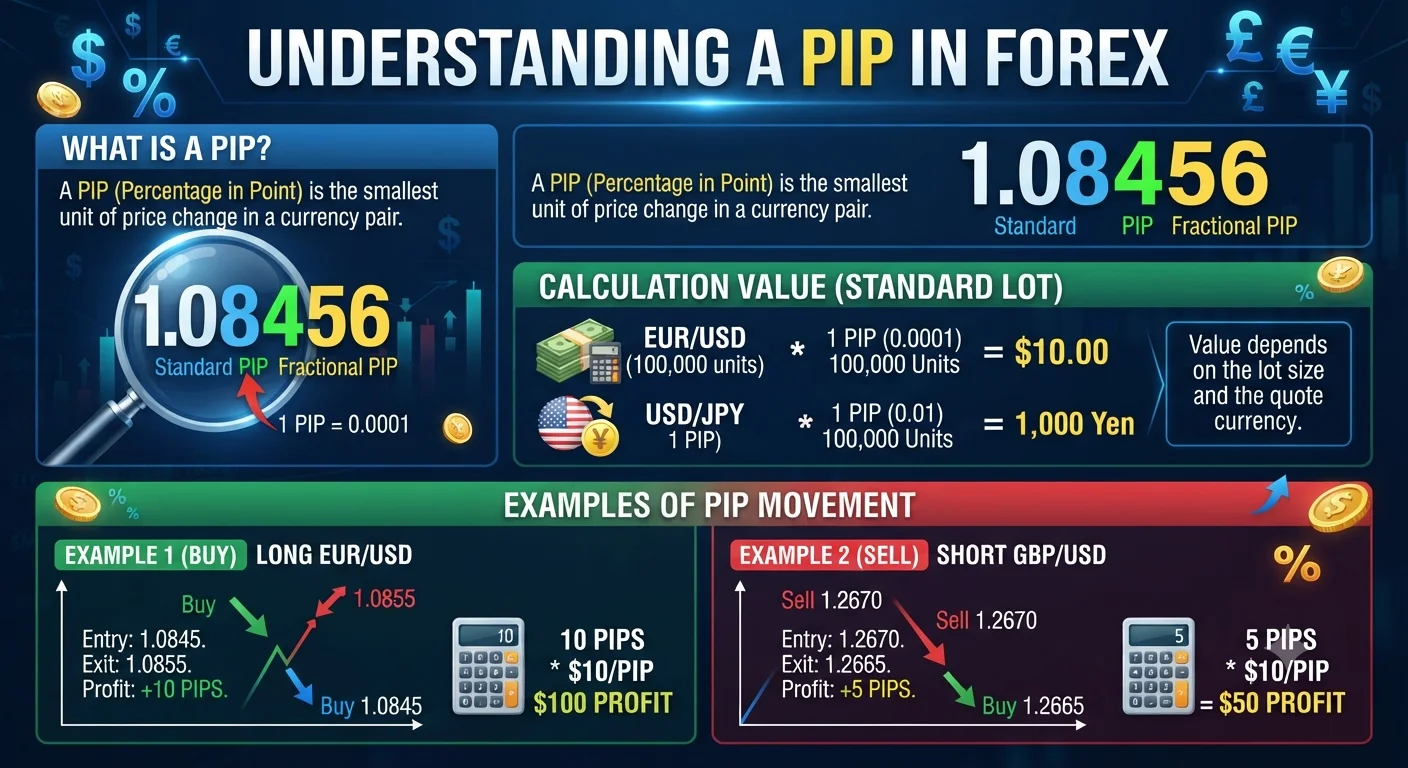
A pip stands for percentage in point or sometimes price interest point. It is the smallest standardised unit of price movement in a forex currency pair.
For the vast majority of currency pairs one pip is a movement of 0.0001 in the exchange rate. This is the fourth decimal place.
If EUR/USD moves from 1.0850 to 1.0851 that is a movement of one pip. If it moves from 1.0850 to 1.0900 that is a movement of 50 pips.
This standardised unit exists so that traders can communicate about price movements without confusion across different currency pairs that trade at very different price levels. A 50 pip move in EUR/USD at 1.0850 and a 50 pip move in GBP/USD at 1.2700 both represent 50 units of the fourth decimal place even though the absolute price levels are different.
The Japanese Yen Exception
The Japanese yen is the most significant exception to the fourth decimal place rule. Because the yen trades at a much higher nominal value relative to the dollar and other major currencies yen pairs are quoted to only two decimal places.
For USD/JPY and any other pair where the yen is the quote currency one pip is a movement of 0.01 meaning the second decimal place.
If USD/JPY moves from 149.50 to 149.51 that is one pip. If it moves from 149.50 to 150.50 that is 100 pips.
- How to Read Forex Charts: Candlestick Patterns for Beginners
- What is Forex Trading? A Beginners Complete Guide for 2026
This is a very common source of confusion for beginners who apply the fourth decimal rule to yen pairs and arrive at completely wrong pip counts. Always check which currency is the quote currency before counting pips.
Pipettes and Fractional Pips
Many modern forex brokers quote prices to five decimal places for most pairs and three decimal places for yen pairs. The fifth decimal place is called a pipette or a fractional pip.
A pipette is one tenth of a pip. So if EUR/USD is quoted at 1.08504 and moves to 1.08507 that is a movement of 0.3 pips or 3 pipettes.
Fractional pip pricing was introduced as brokers gained access to better interbank pricing. It allows brokers to offer tighter spreads and more precise execution. A spread of 0.8 pips for example can only be expressed if fractional pips are available.
For most trading calculations you will work in whole pips. Pipettes matter primarily when comparing broker spreads where differences of 0.2 or 0.3 pips can be significant for high frequency traders.
How to Calculate Pip Value
Knowing what a pip is tells you how far price moved. Knowing the pip value tells you how much money that movement represents in your account currency. These are two different things and both are essential.
Pip value depends on three factors. The currency pair being traded. The lot size of your trade. The exchange rate between the quote currency and your account currency.
Standard Lot Pip Value
The standard lot in forex is 100,000 units of the base currency. For most major pairs where USD is the quote currency the pip value of one standard lot is always exactly 10 dollars.
EUR/USD: one pip on one standard lot = 10 USD GBP/USD: one pip on one standard lot = 10 USD AUD/USD: one pip on one standard lot = 10 USD
This consistency makes calculation very straightforward when USD is the quote currency.
Pip Value When USD is the Base Currency
When USD is the base currency as in USD/JPY or USD/CAD the pip value in USD depends on the current exchange rate.
For USD/JPY the formula is: Pip value = (0.01 divided by current USD/JPY rate) multiplied by lot size
If USD/JPY is at 149.50 the pip value for one standard lot is: (0.01 divided by 149.50) multiplied by 100,000 = approximately 6.69 USD per pip
Recommended Articles
 FOREX TRADING
 FOREX TRADING
 FOREX TRADING
 FOREX TRADING
Pip Value for Cross Pairs
For pairs that do not include USD such as EUR/GBP or GBP/JPY the pip value must be converted to your account currency using the relevant exchange rate. Most trading platforms do this automatically and display your profit and loss in your chosen account currency.
Mini Lots and Micro Lots
Not all traders use standard lots. Mini lots are 10,000 units and produce pip values one tenth the size of standard lots. Micro lots are 1,000 units and produce pip values one hundredth the size.
For EUR/USD: Standard lot (100,000 units): 10 USD per pip Mini lot (10,000 units): 1 USD per pip Micro lot (1,000 units): 0.10 USD per pip
Micro lots are ideal for beginners who want to trade with real money while keeping individual pip values small enough to practise proper risk management without excessive financial exposure.
Pip Value in Different Account Currencies
If your trading account is denominated in a currency other than USD you need to convert the pip value from USD into your account currency using the current exchange rate.
If your account is in British pounds and you calculate a pip value of 10 USD for EUR/USD you would divide that by the current GBP/USD rate to get the value in pounds.
At GBP/USD 1.2700: 10 USD divided by 1.2700 = approximately 7.87 GBP per pip per standard lot.
Again most trading platforms perform this conversion automatically. Understanding the underlying calculation matters because it allows you to verify platform figures and ensures you understand exactly what is at stake on each trade.
Real Trade Examples With Pip Calculations
These examples demonstrate how pip value connects to real profit and loss outcomes.
Example One: EUR/USD Long Trade
Account currency: USD Trade size: 1 standard lot (100,000 EUR) Entry: 1.0850 Exit: 1.0920 Direction: Buy (long)
Pips gained: 1.0920 minus 1.0850 = 0.0070 = 70 pips Pip value: 10 USD per pip for standard lot with USD as quote currency Profit: 70 multiplied by 10 = 700 USD
Example Two: USD/JPY Short Trade
Account currency: USD Trade size: 1 mini lot (10,000 USD) Entry: 149.80 Exit: 149.20 Direction: Sell (short)
Pips gained: 149.80 minus 149.20 = 0.60 = 60 pips Pip value for mini lot: (0.01 divided by 149.50) multiplied by 10,000 = approximately 0.67 USD per pip Profit: 60 multiplied by 0.67 = approximately 40 USD
Example Three: Stop Loss Calculation
Account: 5,000 USD Risk per trade: 1% of account = 50 USD Trade: EUR/USD long Pip value: 1 USD per pip (mini lot)
Maximum pips risked: 50 USD divided by 1 USD per pip = 50 pips Stop loss placement: 50 pips below entry
If entry is at 1.0850 the stop loss is placed at 1.0800.
This is precisely how professional traders use pip value to size positions correctly. They start with their risk amount in dollars and work backwards to determine both position size and stop loss placement.
Common Pip Calculation Mistakes
Applying the fourth decimal rule to yen pairs is the most frequent error. Always use the second decimal for JPY pairs.
Confusing pips with pipettes creates errors in spread calculations and profit estimations particularly when using brokers who quote to five decimal places.
Ignoring lot size when calculating pip value leads to significant misunderstanding of actual monetary risk. A 50 pip stop loss means something very different on a standard lot compared to a micro lot.
Forgetting to account for the spread means a trade starts at an immediate loss equal to the spread cost. If the spread on EUR/USD is 1.2 pips and you trade one standard lot your trade must move 1.2 pips in your favour before you break even.
Conclusion
A pip is the basic unit of measurement in forex trading. Every profit every loss every stop loss and every take profit level is defined in pips and then converted to monetary value using the pip value formula based on your position size.
Mastering this calculation takes the mystery out of position sizing. You no longer guess how much you are risking on a trade. You calculate it precisely before you enter and adjust your lot size until the monetary risk matches your account management rules.
Practice pip calculations on every trade setup before you execute. Within weeks it becomes automatic and fast. That precision is one of the clearest markers that separates traders who manage their risk from those who merely hope for the best.
DISCLAIMER: This article is for educational and informational purposes only. It does not constitute financial or investment advice. Forex trading involves significant risk of loss. Always conduct your own research before trading.
RELATED ARTICLES: What is Forex Trading? A Beginner's Complete Guide for 2025 How to Read Forex Charts: Candlestick Patterns for Beginners Forex Leverage Explained: How It Works and Why It Is Dangerous