Introduction
If you've ever wondered how traders control large positions in the forex market with only a small amount of capital, the answer is leverage.
Leverage is one of the most powerful — and most misunderstood — concepts in forex trading. Used correctly, it can amplify your profits significantly. Used carelessly, it can wipe out your entire trading account in minutes.
In this guide, you'll learn exactly what forex leverage is, how it works with real numerical examples, what the risks are, and how to use it responsibly as a beginner.
What is Forex Leverage?
- Introduction
- What is Forex Leverage?
- How Does Forex Leverage Work? (Step-by-Step Example)
- Common Leverage Ratios in Forex
- What is Margin in Forex?
- The Risks of Forex Leverage
- 1. Amplified Losses
- 2. Margin Calls and Stop Outs
- 3. Emotional Trading Under Pressure
- 4. Overnight Swap Fees
- 5. Market Gaps
- How to Use Leverage Safely: 5 Rules for Beginners
- Leverage Calculator: Quick Reference
- Leverage vs. No Leverage: Which Is Better?
- What Leverage Should a Beginner Use?
- Summary
- Frequently Asked Questions (FAQ)
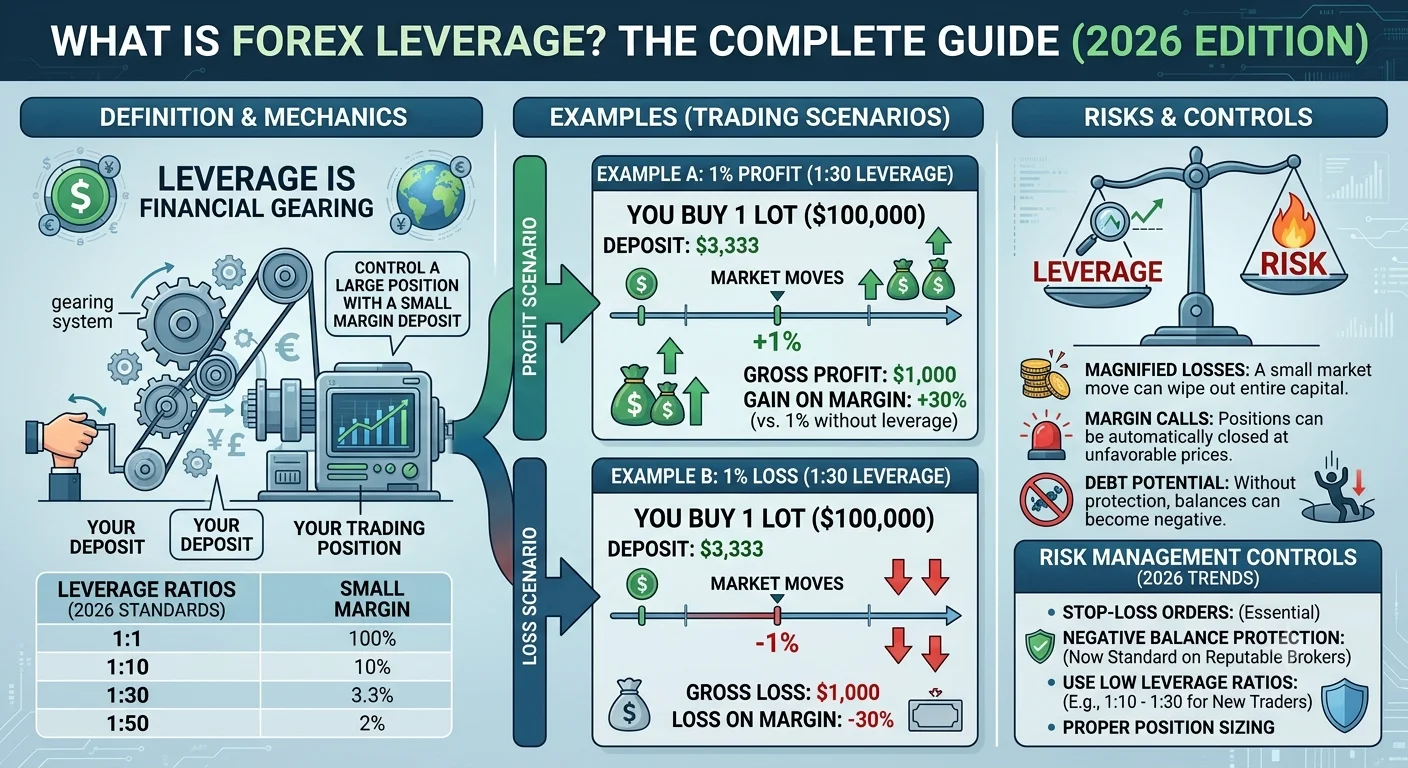
Forex leverage is a tool that allows traders to control a position larger than their actual deposit. It is essentially a loan provided by your broker that lets you open trades worth far more than the money you have in your account.
Leverage is expressed as a ratio, such as 1:10, 1:50, 1:100, or even 1:500. This ratio tells you how much your broker multiplies your trading capital.
For example:
- With 1:100 leverage, you can control $100,000 worth of currency with just $1,000 of your own money.
- With 1:50 leverage, you need $2,000 to control the same $100,000 position.
This is why leverage is sometimes called "trading on margin" — you only need to put up a small percentage of the total trade value (the margin) to open a position.
How Does Forex Leverage Work? (Step-by-Step Example)
Let's walk through a real-world scenario so you can see exactly how leverage operates.
Scenario: Trading EUR/USD with 1:100 Leverage
Suppose the EUR/USD exchange rate is 1.1000, and you believe the Euro will rise against the US Dollar.
| Detail | Value |
|---|---|
| Your account balance | $1,000 |
| Leverage ratio | 1:100 |
| Maximum position size | $100,000 |
| EUR/USD rate | 1.1000 |
| Trade size (1 standard lot) | 100,000 EUR |
| Margin required | $1,000 |
You open a buy (long) position of 1 standard lot at 1.1000.
If the trade goes in your favour:
The price moves up to 1.1100 — a 100-pip gain.
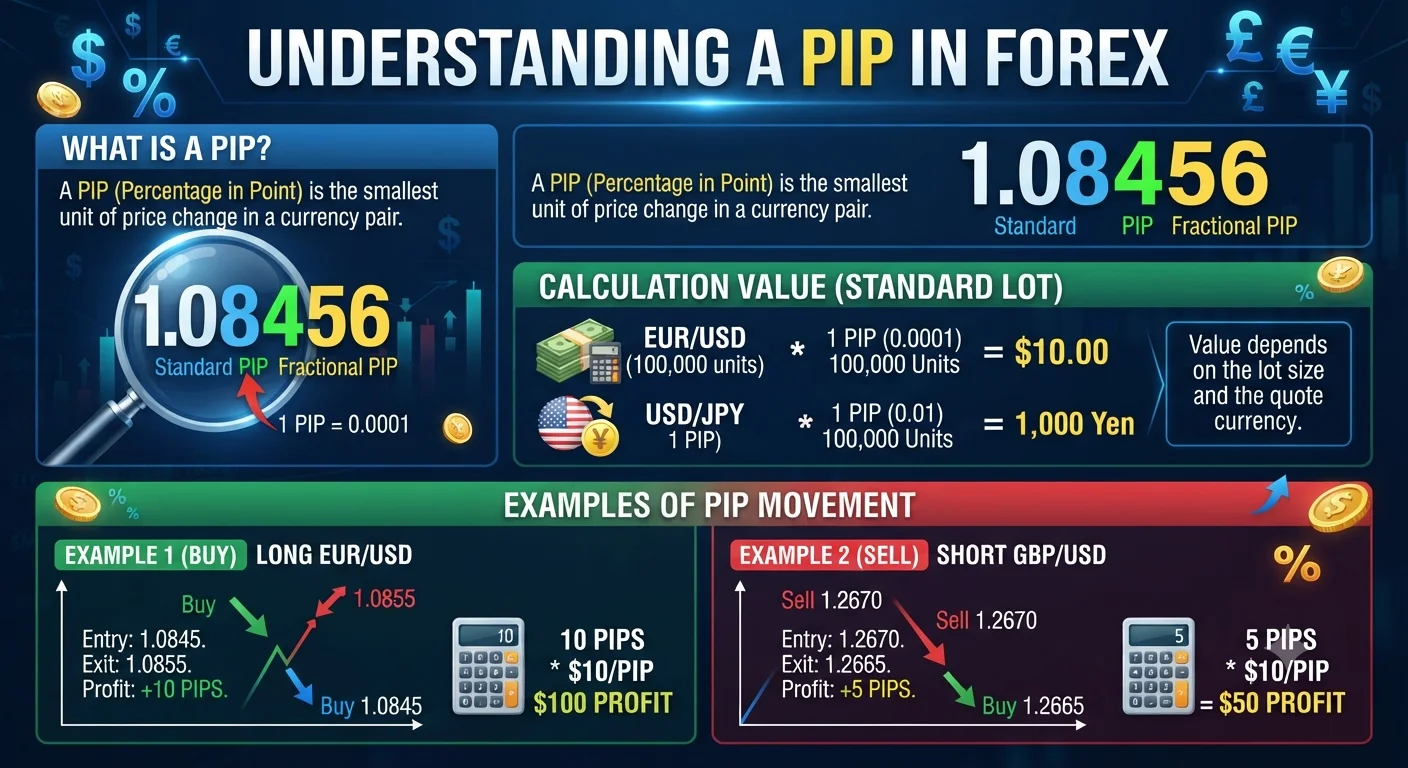
Each pip on a standard lot of EUR/USD is worth approximately $10. So:
- Profit = 100 pips × $10 = $1,000
- You've doubled your account in a single trade.
If the trade goes against you:
The price drops to 1.0900 — a 100-pip loss.
- Loss = 100 pips × $10 = $1,000
- Your entire $1,000 account is wiped out.
This is the double-edged nature of leverage. The same tool that doubles your profit can just as quickly eliminate your capital.
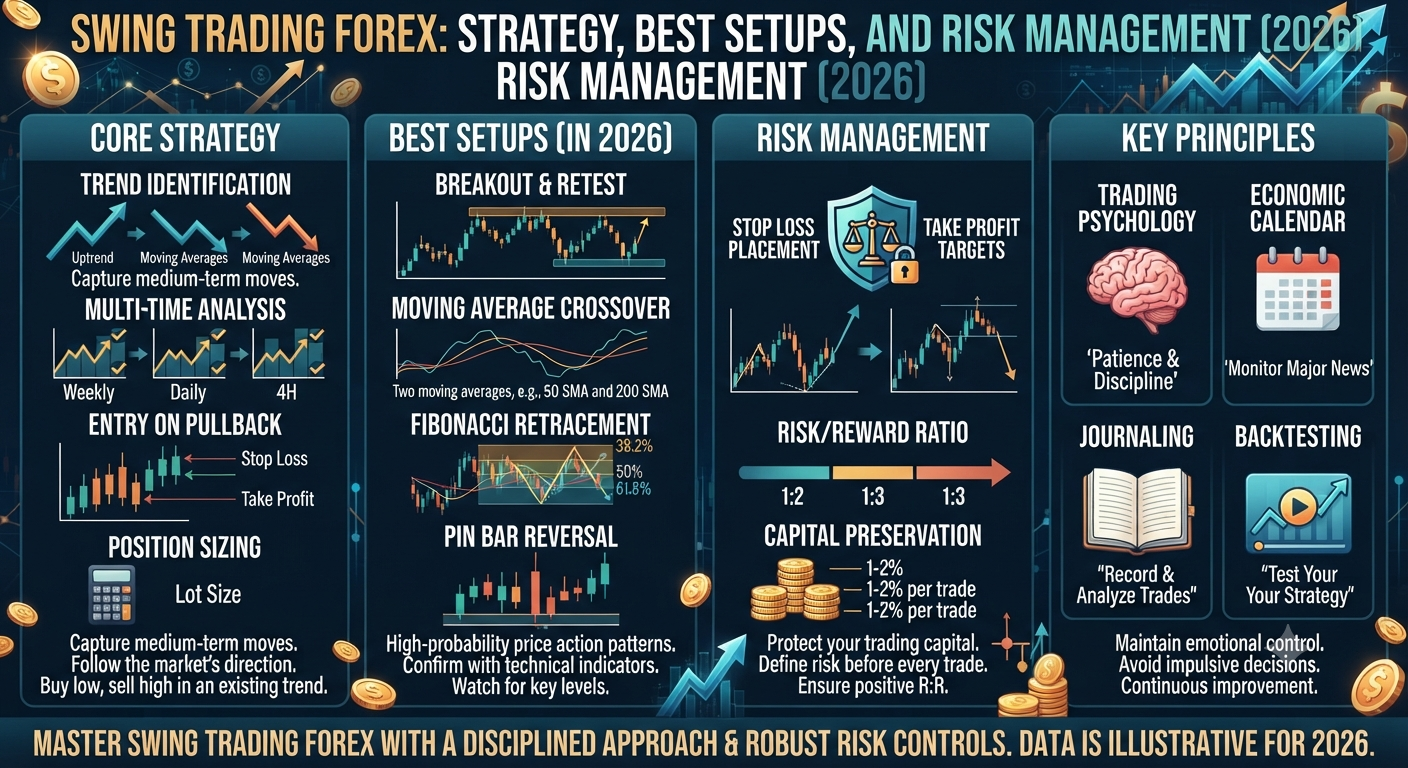
- What is a Pip in Forex? Calculation Value and Examples
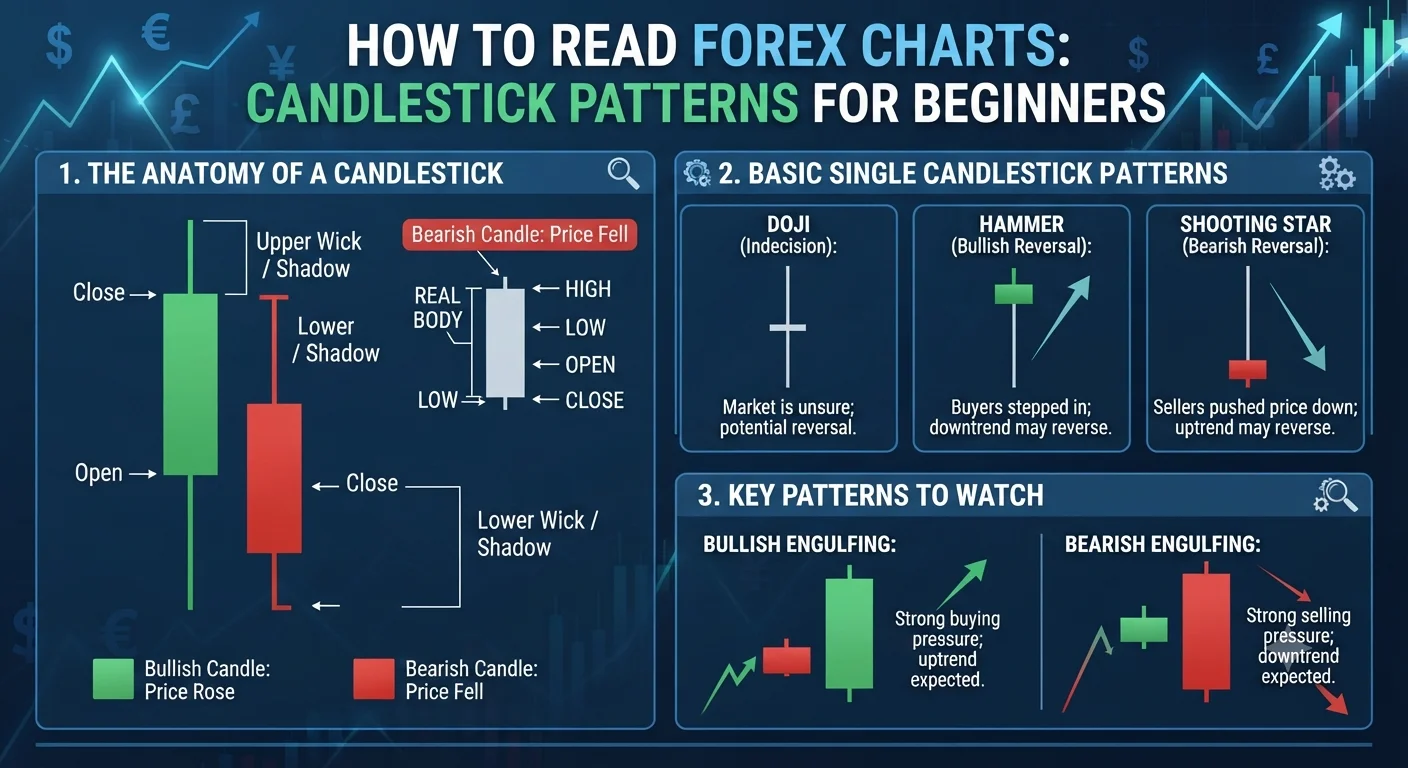
- How to Read Forex Charts: Candlestick Patterns for Beginners
Common Leverage Ratios in Forex
Different brokers offer different leverage levels depending on the jurisdiction they operate in and the account type. Here's a quick overview of the most common ratios:
| Leverage Ratio | Margin Required | Control Over |
|---|---|---|
| 1:10 | 10% | $10,000 with $1,000 |
| 1:30 | 3.3% | $30,000 with $1,000 |
| 1:50 | 2% | $50,000 with $1,000 |
| 1:100 | 1% | $100,000 with $1,000 |
| 1:200 | 0.5% | $200,000 with $1,000 |
| 1:500 | 0.2% | $500,000 with $1,000 |
Regulatory note: In Europe (ESMA regulations) and the UK (FCA), retail traders are capped at 1:30 leverage for major currency pairs. In other regions such as parts of Asia and offshore brokers, leverage of 1:500 or higher is available. High leverage does not mean high returns — it means higher risk.
What is Margin in Forex?
Margin and leverage are closely connected but they are not the same thing.
Margin is the amount of money your broker requires you to deposit to open and maintain a leveraged position. It acts as a security deposit.
Leverage is the ratio that determines how large a position you can open with that margin.
Here's the relationship:
Required Margin = Trade Size ÷ Leverage Ratio
So for a $100,000 trade at 1:100 leverage:
Required Margin = $100,000 ÷ 100 = $1,000
When your account balance falls close to the required margin level, your broker may issue a margin call — a warning that you need to deposit more funds or close some positions. If you don't act, the broker may automatically close your trades to prevent further loss. This is called a stop out.
The Risks of Forex Leverage
Leverage is the number one reason why most beginner traders lose money quickly. Here are the main risks you need to understand before using it:
1. Amplified Losses
Just as leverage amplifies profits, it amplifies losses at exactly the same rate. A 1% move against you at 1:100 leverage means a 100% loss of your margin.
2. Margin Calls and Stop Outs
If the market moves sharply against you, your broker will force-close your positions — often at the worst possible time.
3. Emotional Trading Under Pressure
High leverage increases the emotional pressure on traders. Fear of a large loss often leads to panic decisions, premature exits, or revenge trading.
Recommended Articles
 FOREX TRADING
 FOREX TRADING
 FOREX TRADING
 FOREX TRADING
4. Overnight Swap Fees
When you hold a leveraged position overnight, your broker charges a swap fee (rollover cost). On high-leverage positions, these fees can accumulate quickly.
5. Market Gaps
During news events or market openings after weekends, price can "gap" — jumping several pips instantly. Your stop-loss order may not execute at the intended price, causing a larger loss than expected.
How to Use Leverage Safely: 5 Rules for Beginners
Just because leverage is risky doesn't mean you should avoid it entirely. Here's how experienced traders manage leverage responsibly:
1. Start with Low Leverage As a beginner, use 1:10 or 1:20 at most. Get comfortable with how the market moves before increasing your exposure.
2. Always Use a Stop-Loss A stop-loss order automatically closes your position at a predetermined price, capping your maximum loss. Never open a leveraged trade without one.
3. Risk Only 1–2% Per Trade Professional traders rarely risk more than 1–2% of their total account on any single trade. This means on a $1,000 account, your maximum loss per trade should be $10–$20.
4. Calculate Your Position Size Before every trade, calculate exactly how many lots you should trade based on your stop-loss distance and your risk tolerance. Never guess.
5. Use a Demo Account First Practice with virtual money until you fully understand how leverage affects your positions. Most brokers offer free demo accounts with real market conditions.
Leverage Calculator: Quick Reference
Use this table to see how much capital you risk based on your account size and leverage:
| Account Size | Leverage | Max Position | Pips to Lose Account |
|---|---|---|---|
| $500 | 1:10 | $5,000 | 500 pips |
| $500 | 1:50 | $25,000 | 100 pips |
| $500 | 1:100 | $50,000 | 50 pips |
| $1,000 | 1:10 | $10,000 | 500 pips |
| $1,000 | 1:50 | $50,000 | 100 pips |
| $1,000 | 1:100 | $100,000 | 50 pips |
Based on EUR/USD with $10 per pip on a standard lot. Actual values vary by pair and broker.
Leverage vs. No Leverage: Which Is Better?
Some traders choose to trade without leverage, especially when starting out. Here's a simple comparison:
| Factor | With Leverage | Without Leverage |
|---|---|---|
| Profit potential | High | Low |
| Risk level | High | Low |
| Capital required | Low | High |
| Suitable for beginners | No | Yes |
| Suitable for professionals | Yes (managed carefully) | Yes |
For long-term investors who buy and hold, leverage is generally not recommended. For short-term traders looking to profit from small daily price movements, carefully managed leverage is often necessary to make trading worthwhile.
What Leverage Should a Beginner Use?
Most professional traders and financial educators recommend that beginners use no more than 1:10 leverage. Some suggest starting with zero leverage (trading with your own capital only) until you have at least 3–6 months of consistent demo trading results.
The lower your leverage, the more time and room your trades have to develop before hitting a margin call. This reduces emotional pressure and gives you a better learning environment.
Summary
Leverage is a powerful but dangerous tool in forex trading. It lets you control large positions with a small amount of capital, multiplying both your potential profits and your potential losses equally.
The key takeaways from this guide:
- Leverage is expressed as a ratio (e.g., 1:100) and determines how large a position you can open relative to your deposit.
- Margin is the collateral your broker holds while your trade is open.
- High leverage dramatically increases the risk of losing your entire account quickly.
- Always use a stop-loss, risk no more than 1–2% per trade, and start with low leverage.
- Practice on a demo account before trading with real money.
Frequently Asked Questions (FAQ)
What is leverage in forex trading?
Forex leverage is a ratio provided by your broker that allows you to control a trade position larger than your actual account balance. For example, 1:100 leverage lets you control $100,000 with just $1,000 of your own money.
What does 1:100 leverage mean in forex?
A 1:100 leverage ratio means that for every $1 in your account, you can open a trade worth $100. So with $500, you could control a $50,000 position in the market.
Is high leverage good or bad for beginners?
High leverage is generally bad for beginners. It amplifies losses just as much as profits, and a small adverse price movement can wipe out your account quickly. Beginners should start with 1:10 leverage or lower.
What happens if I lose more than my balance with leverage?
Most regulated forex brokers provide negative balance protection, meaning you cannot lose more than the funds in your account. If your balance hits zero, the broker closes your positions automatically.
What is the difference between leverage and margin in forex?
Leverage is the ratio that determines your maximum position size. Margin is the actual dollar amount your broker requires you to deposit to open that position. They are two sides of the same concept.
What leverage do professional forex traders use?
Most professional traders use conservative leverage — typically between 1:5 and 1:20 — even when higher leverage is available. They prioritize capital preservation over maximising position size.