Introduction
Imagine a bank that never closes, charges minimal fees, requires no credit check, asks for no ID, and is controlled by no single government or corporation. That is the core promise of DeFi — Decentralized Finance.
DeFi is one of the most transformative and talked-about developments in the history of finance. It has grown from a niche experiment in 2018 to a multi-billion dollar ecosystem that allows people worldwide to lend, borrow, trade, and earn interest on their crypto assets — without any traditional financial institution in the middle.
But DeFi also carries enormous risks. Smart contract bugs, hacks, rug pulls, and extreme volatility have cost investors billions of dollars.
In this guide, you'll get a complete, honest picture of what DeFi is, how it works, the biggest platforms, and whether it makes sense for you as a beginner.
What is DeFi?
- Introduction
- What is DeFi?
- Traditional Finance vs DeFi: Key Differences
- How Does DeFi Work?
- The Building Blocks of DeFi
- 1. Decentralized Exchanges (DEXs)
- 2. Lending and Borrowing Protocols
- 3. Stablecoins
- 4. Yield Farming and Liquidity Mining
- 5. Derivatives and Synthetic Assets
- 6. Insurance Protocols
- Real DeFi Examples: How They Work in Practice
- Example 1: Earning Interest with Aave
- Example 2: Trading on Uniswap
- Example 3: Borrowing Against Your Crypto (MakerDAO)
- Total Value Locked (TVL) — How Big is DeFi?
- The Real Risks of DeFi
- 1. Smart Contract Risk
- 2. Rug Pulls and Scams
- 3. Liquidation Risk
- 4. Impermanent Loss
- 5. Regulatory Uncertainty
- 6. Gas Fees (Network Fees)
- Is DeFi Safe for Beginners?
- Top DeFi Platforms to Know in 2026
- Summary
- Frequently Asked Questions (FAQ)
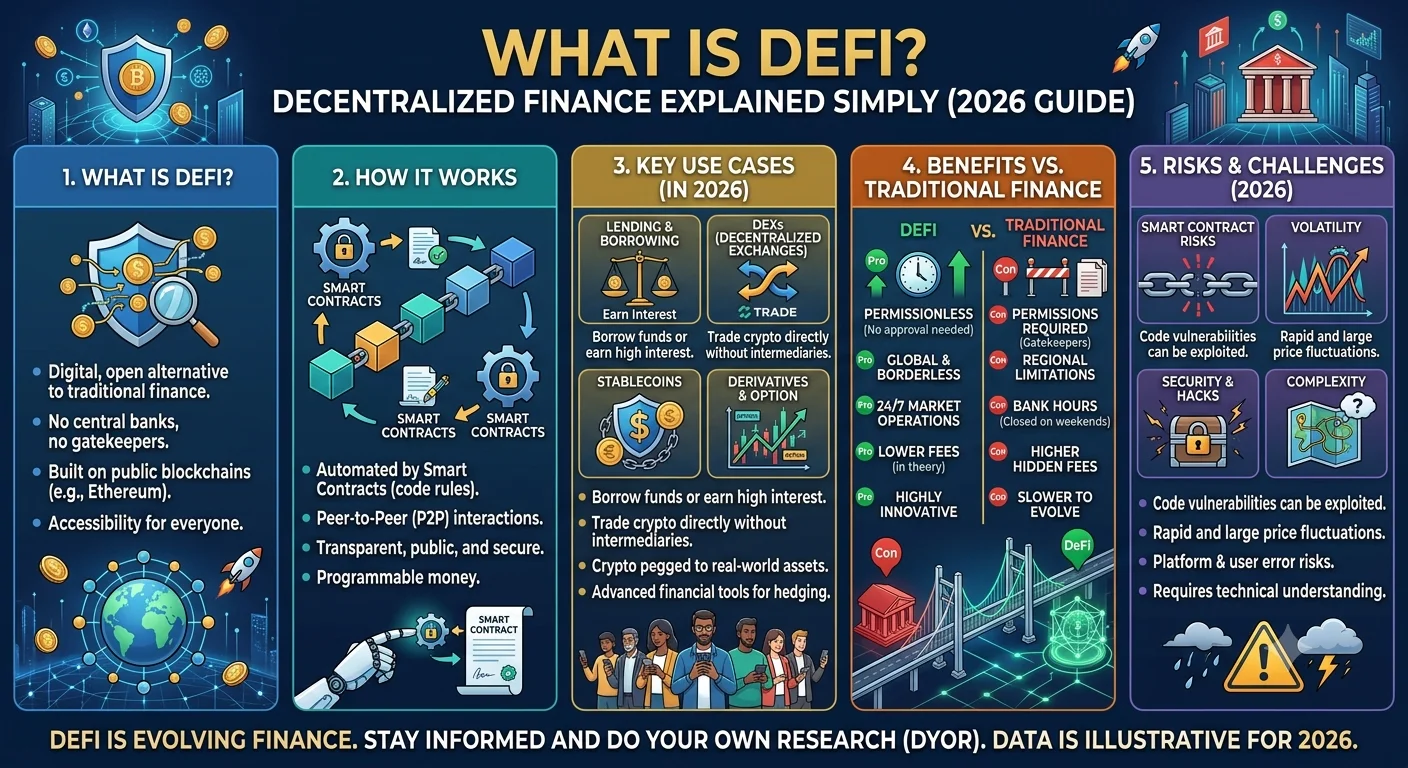
DeFi stands for Decentralized Finance. It refers to a collection of financial applications built on blockchain networks — primarily Ethereum — that operate without centralized intermediaries such as banks, brokers, or exchanges.
Traditional finance (sometimes called "TradFi") relies on institutions to hold your money, process transactions, and enforce agreements. DeFi replaces these institutions with smart contracts — self-executing pieces of code that automatically carry out financial agreements when certain conditions are met.
In simple terms: instead of trusting a bank to lend your money and pay you interest, you deposit your funds into a smart contract, which automatically lends it to borrowers and pays you interest — all without a human in between.
Traditional Finance vs DeFi: Key Differences
| Feature | Traditional Finance (TradFi) | Decentralized Finance (DeFi) |
|---|---|---|
| Who controls funds | Banks, institutions | Smart contracts (code) |
| Who can access | Anyone with a bank account | Anyone with a crypto wallet |
| ID required | Yes (KYC/AML) | No |
| Operating hours | Business hours | 24/7/365 |
| Transparency | Private/internal | Fully public on blockchain |
| Transaction speed | 1–5 business days | Seconds to minutes |
| Interest rates | Set by central banks | Set by supply/demand algorithms |
| Risk of failure | Systemic (bank runs) | Smart contract bugs, hacks |
How Does DeFi Work?
DeFi applications are built on top of smart contract platforms — blockchains that can execute code. Ethereum is by far the dominant platform for DeFi, though others like Solana, Avalanche, and BNB Chain also host significant DeFi ecosystems.
Here's how the basic flow works:
Step 1: You connect your crypto wallet (such as MetaMask) to a DeFi application.
Step 2: You deposit cryptocurrency into a smart contract. No registration, no password, no KYC.
Step 3: The smart contract automatically executes the agreed function — for example, lending your crypto to borrowers in exchange for interest.
Step 4: Interest or rewards accumulate and can be withdrawn at any time by you — the smart contract has no power to block or delay your access.
Because the code runs on a public blockchain, anyone can inspect it. Every transaction is permanently recorded and visible. The system is transparent in a way that no traditional bank ever could be.
The Building Blocks of DeFi
DeFi is not a single product — it is an entire ecosystem of financial tools. Here are the core categories:
1. Decentralized Exchanges (DEXs)
DEXs allow users to trade cryptocurrencies directly with each other without a centralized order book. Trades are executed through liquidity pools — pools of tokens provided by other users who earn trading fees in return.
Examples: Uniswap, SushiSwap, Curve Finance, dYdX
2. Lending and Borrowing Protocols
These platforms allow users to deposit crypto as collateral and borrow other assets against it, or to lend their crypto to earn interest. Interest rates are set algorithmically based on supply and demand.
Examples: Aave, Compound, MakerDAO
3. Stablecoins
Stablecoins are cryptocurrencies pegged to a stable asset like the US Dollar. In DeFi, algorithmic and crypto-collateralized stablecoins (such as DAI) are widely used to reduce volatility while still participating in DeFi protocols.
Examples: DAI, USDC, FRAX
4. Yield Farming and Liquidity Mining
Users deposit crypto into DeFi protocols to earn rewards — often paid in the platform's governance token. This practice, called yield farming, can offer high returns but comes with significant risk.
5. Derivatives and Synthetic Assets
Some DeFi platforms allow users to create or trade synthetic versions of real-world assets — such as synthetic stocks or commodities — on the blockchain.
Examples: Synthetix, GMX, Gains Network
6. Insurance Protocols
Given the risk of smart contract hacks, DeFi insurance protocols allow users to buy coverage against specific protocol failures.
Examples: Nexus Mutual, InsurAce
Real DeFi Examples: How They Work in Practice
Example 1: Earning Interest with Aave
You deposit 1 ETH into Aave's lending pool. Other users borrow that ETH and pay interest. Aave's smart contract automatically distributes your share of that interest to you. You can withdraw your 1 ETH plus accumulated interest at any time.
Example 2: Trading on Uniswap
You want to swap USDC (a stablecoin) for a newer token. You go to Uniswap, connect your MetaMask wallet, and the trade is executed instantly against a liquidity pool. No sign-up, no waiting, no middleman. Uniswap charges a small trading fee (typically 0.3%) which goes to liquidity providers.
Example 3: Borrowing Against Your Crypto (MakerDAO)
You hold ETH but don't want to sell it. You deposit ETH into MakerDAO as collateral and borrow DAI (a USD-pegged stablecoin). You now have liquidity in dollars while still holding your ETH. If ETH's price falls too much, your collateral gets automatically liquidated to cover the loan.
Recommended Articles
 BLOCKCHAIN WEB3
 BLOCKCHAIN WEB3
Total Value Locked (TVL) — How Big is DeFi?
A key metric for measuring DeFi's size and activity is Total Value Locked (TVL) — the total amount of crypto assets deposited in DeFi protocols at any given time.
According to DeFiLlama, DeFi TVL peaked at over $180 billion in late 2021, contracted significantly during the 2022 bear market, and has been gradually recovering. In 2026, the ecosystem is more mature, with improved security standards and broader institutional participation.
The Real Risks of DeFi
DeFi is exciting, but it has cost billions of dollars in losses. Here are the most important risks every beginner must understand before participating:
1. Smart Contract Risk
Smart contracts are code, and code can have bugs. If a vulnerability exists in a protocol's smart contract, hackers can exploit it to drain funds. Even audited protocols have been hacked. According to Chainalysis, over $3.8 billion was stolen from DeFi protocols in 2022 alone.
2. Rug Pulls and Scams
In a rug pull, developers of a DeFi project attract investors, then suddenly withdraw all liquidity and abandon the project — taking everyone's funds. This is extremely common with new, unaudited protocols offering unrealistically high yields.
Rule: If an annual percentage yield (APY) sounds too good to be true (e.g., 1,000% APY), it almost certainly is.
3. Liquidation Risk
When you borrow in DeFi using crypto collateral, your position can be automatically liquidated if the value of your collateral falls below a certain threshold. In highly volatile markets, this can happen very quickly.
4. Impermanent Loss
If you provide liquidity to a DEX like Uniswap, you are exposed to impermanent loss — a reduction in value compared to simply holding your tokens, caused by price divergence between the two tokens in your liquidity pair.
5. Regulatory Uncertainty
Governments worldwide are still developing regulations around DeFi. Future regulations could restrict access to certain protocols or require identity verification — changing the DeFi landscape significantly.
6. Gas Fees (Network Fees)
On Ethereum, every DeFi transaction requires a "gas fee" paid to the network. During periods of high activity, these fees can become very expensive — sometimes more than the transaction itself for small amounts.
Is DeFi Safe for Beginners?
DeFi is not recommended as a starting point for complete crypto beginners. The risks are real and the learning curve is steep. However, if you want to explore DeFi, here is a sensible progression:
- First: Learn the basics of crypto, wallets, and blockchain (read our guide on What is Blockchain?)
- Then: Set up a self-custody wallet like MetaMask and practice sending small amounts
- Next: Try a well-established, audited protocol like Aave or Uniswap with a tiny amount you can afford to lose
- Always: Use reputable protocols with long track records and multiple independent security audits
- Never: Put significant funds into new, unaudited protocols regardless of promised returns
Top DeFi Platforms to Know in 2026
| Platform | Category | Blockchain | Notable Feature |
|---|---|---|---|
| Uniswap | DEX | Ethereum, L2s | Largest decentralized exchange by volume |
| Aave | Lending/Borrowing | Ethereum, Polygon, others | Flash loans, variable & stable rates |
| MakerDAO | Stablecoin/Lending | Ethereum | Issues DAI, one of oldest DeFi protocols |
| Curve Finance | DEX (Stablecoins) | Ethereum, multi-chain | Optimized for low-slippage stablecoin swaps |
| Compound | Lending | Ethereum | Pioneered algorithmic money markets |
| GMX | Perpetuals DEX | Arbitrum, Avalanche | Decentralized leveraged trading |
Summary
DeFi represents one of the most significant innovations in financial history — creating an open, permissionless financial system accessible to anyone with an internet connection and a crypto wallet.
Key takeaways:
- DeFi replaces traditional financial intermediaries with smart contracts running on blockchains
- Core DeFi services include trading (DEXs), lending/borrowing, yield farming, and stablecoins
- The biggest platforms include Uniswap, Aave, MakerDAO, and Compound
- DeFi carries serious risks: smart contract bugs, rug pulls, liquidation, and regulatory uncertainty
- Beginners should start with small amounts on established, well-audited protocols only
Frequently Asked Questions (FAQ)
What is DeFi in simple terms?
DeFi (Decentralized Finance) is a system of financial services — like lending, borrowing, and trading — that runs on blockchain technology without banks or other middlemen. Smart contracts replace institutions, allowing anyone with a crypto wallet to access these services directly.
How does DeFi make money?
DeFi protocols generate revenue through transaction fees, lending interest, and liquidity pool fees. Users who provide liquidity or lend their assets earn a share of these fees as passive income. The protocol itself often distributes fees to holders of its governance token.
Is DeFi safe to invest in?
DeFi carries significant risks including smart contract vulnerabilities, hacks, rug pulls, and extreme price volatility. Established protocols with long track records and multiple security audits are safer, but no DeFi protocol is entirely risk-free. Only invest what you can afford to lose completely.
What is the difference between DeFi and Bitcoin?
Bitcoin is primarily a decentralized digital currency and store of value. DeFi refers to a broader ecosystem of financial applications — mostly built on Ethereum — that replicate financial services like lending, trading, and insurance using smart contracts. Bitcoin itself has limited DeFi functionality in its native form.
What is TVL in DeFi?
TVL stands for Total Value Locked — the total dollar value of all crypto assets currently deposited in DeFi protocols. It is the most widely used metric to measure the size, growth, and health of the DeFi ecosystem. Higher TVL generally indicates greater user trust and protocol usage.
Can I lose all my money in DeFi?
Yes. Smart contract exploits, rug pulls, sudden market crashes, and liquidations have caused total loss of funds for many DeFi participants. This is why risk management, starting small, and sticking to well-audited protocols is absolutely critical for anyone entering the DeFi space.