Introduction
Most beginners who discover forex trading imagine sitting at multiple monitors, making dozens of trades per day, constantly watching the market. That picture describes day trading — and for most people, it is exhausting, stressful, and impractical.
Swing trading offers a far more sustainable alternative. It is one of the most popular and effective trading styles used by both retail traders and professional fund managers worldwide.
With swing trading, you hold positions for several days to a few weeks, capturing larger price "swings" without needing to monitor the charts every hour. You can swing trade successfully with just 30–60 minutes of chart analysis per day.
In this complete guide, you will learn exactly what swing trading is, how it differs from other trading styles, the best setups to look for, and how to manage risk professionally.
What is Swing Trading?
- Introduction
- What is Swing Trading?
- Swing Trading vs Day Trading vs Position Trading
- How Swing Trading Works: The Core Concept
- The Best Swing Trading Setups for Forex
- Setup 1: Pullback to Moving Average
- Setup 2: Breakout and Retest
- Setup 3: Fibonacci Retracement Entry
- Setup 4: Double Bottom / Double Top
- Entry and Exit Rules for Swing Traders
- Entry Rules:
- Exit Rules:
- Risk Management for Swing Trading Forex
- The 1% Rule
- Position Sizing Formula
- Stop-Loss Placement
- The Risk-Reward Ratio
- Best Currency Pairs for Swing Trading
- Swing Trading Checklist: Before Every Trade
- Summary
- Frequently Asked Questions (FAQ)
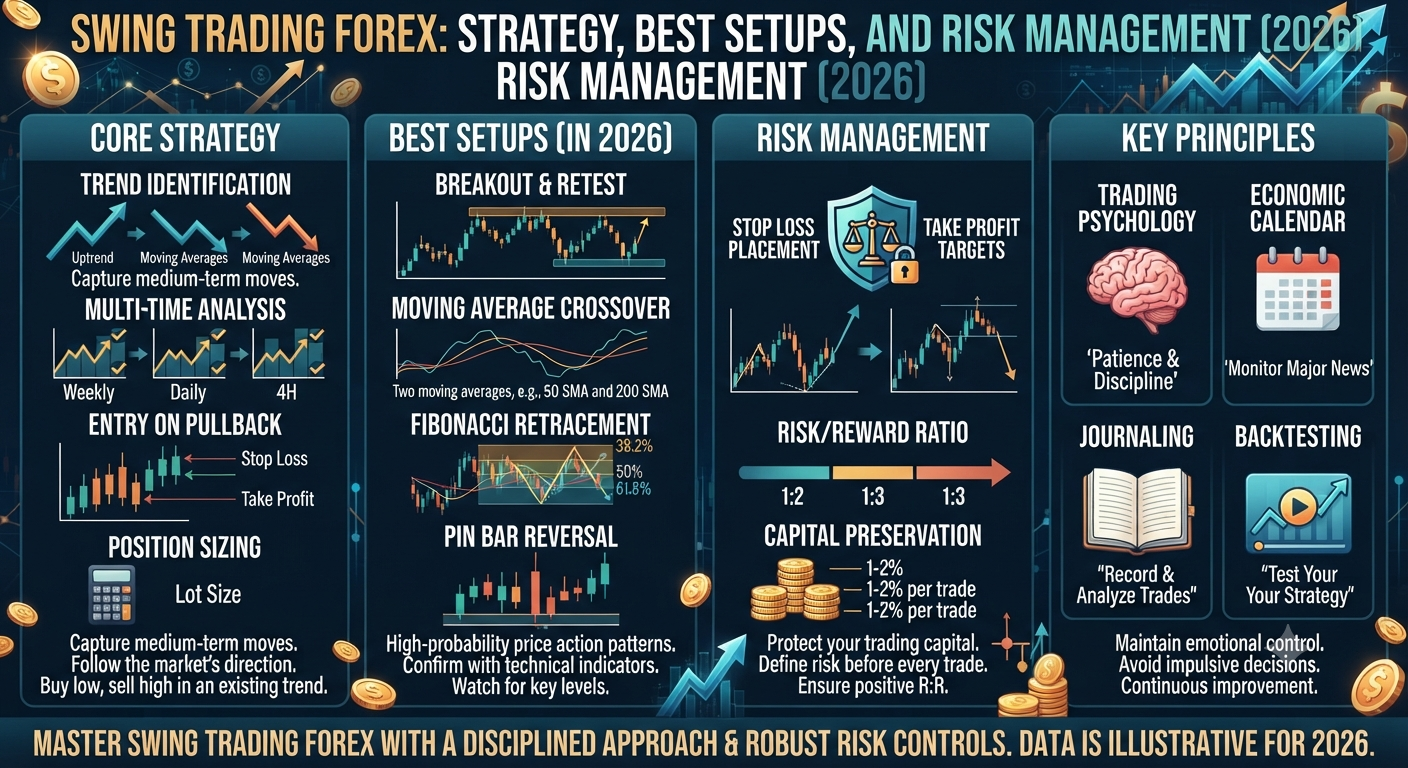
Swing trading is a trading style that aims to capture medium-term price moves — typically lasting from 2 days to several weeks — within a larger trend or between support and resistance levels.
The core idea is to enter a trade at the beginning of a price "swing" and exit before or at the end of that swing, taking the majority of the move as profit.
Swing traders use a combination of technical analysis (chart patterns, indicators) and fundamental analysis (economic events, news) to identify trade opportunities.
Swing Trading vs Day Trading vs Position Trading
Understanding where swing trading fits among other styles helps you decide whether it suits your personality and lifestyle:
| Factor | Scalping | Day Trading | Swing Trading | Position Trading |
|---|---|---|---|---|
| Trade duration | Seconds to minutes | Minutes to hours | Days to weeks | Weeks to months |
| Charts used | 1m, 5m | 15m, 1H | 4H, Daily | Weekly, Monthly |
| Time commitment | Full-time (intense) | Full-time | Part-time (1hr/day) | Minimal |
| Number of trades | Many per day | Several per day | A few per week | A few per month |
| Profit per trade | Very small (pips) | Small-medium | Medium-large | Large |
| Stress level | Very high | High | Medium | Low |
| Best for | Professionals | Dedicated traders | Working adults | Patient investors |
Swing trading is ideal for people who have a full-time job or other commitments but still want to participate actively in the forex market with a disciplined, rule-based approach.
How Swing Trading Works: The Core Concept
Swing traders operate on one fundamental principle: price does not move in a straight line.
Even in a strong uptrend, prices regularly pull back before continuing higher. In a downtrend, prices bounce upward temporarily before falling again. These pullbacks and bounces are the "swings" that swing traders aim to capture.
There are two main approaches:
1. Trend-following swing trading Enter in the direction of the dominant trend after a pullback. For example, in an uptrend, wait for price to pull back to a key support level or moving average, then buy — expecting the trend to resume.
2. Counter-trend swing trading (Range trading) When the market is ranging (moving sideways between clear support and resistance), buy at support and sell at resistance. This approach requires experience to apply safely and is not recommended for beginners.
The Best Swing Trading Setups for Forex
Here are the most reliable and widely used swing trading setups:
Setup 1: Pullback to Moving Average
This is the simplest and most beginner-friendly swing trading setup.
How it works:
- Identify a clear uptrend or downtrend on the Daily chart
- Wait for price to pull back and touch a key moving average — typically the 20 EMA or 50 EMA
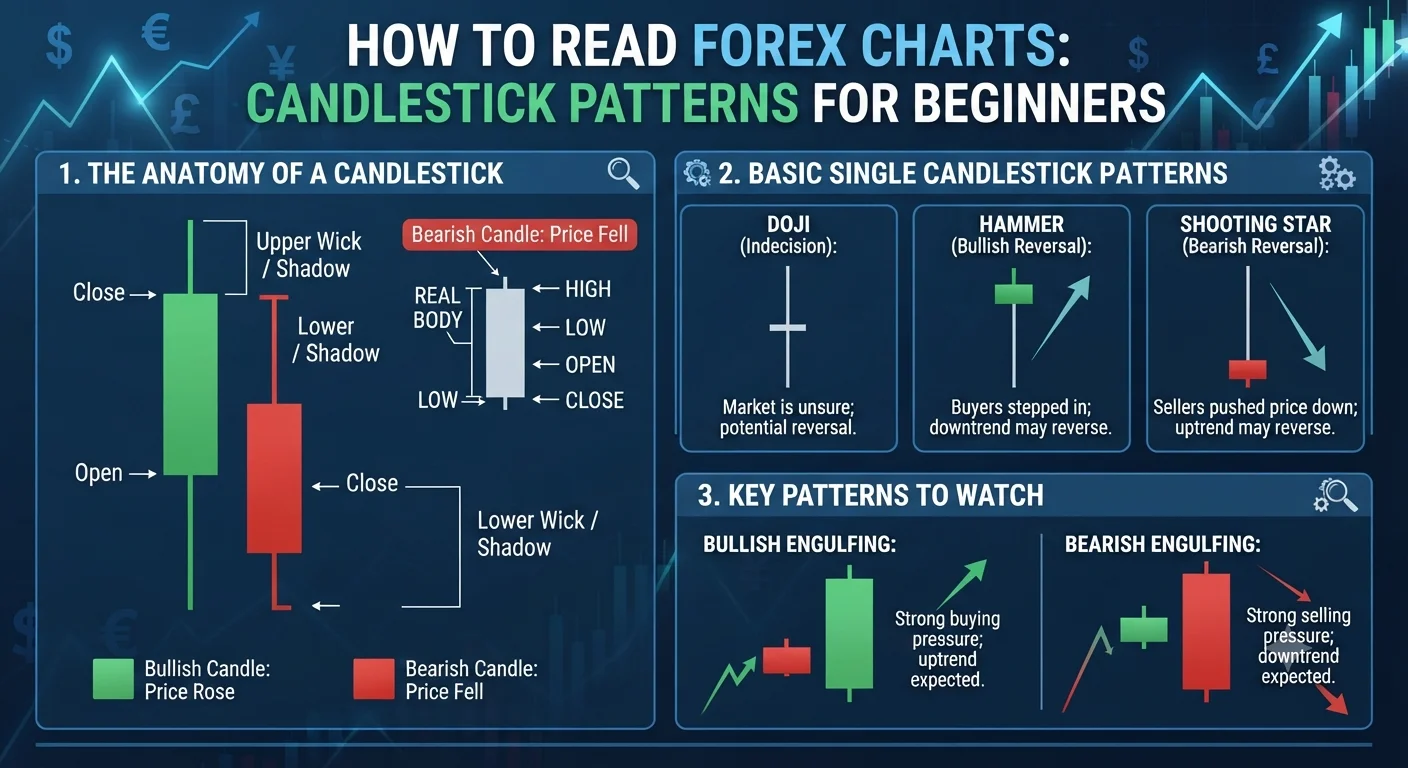
- Look for a bullish candlestick pattern (pin bar, engulfing candle) at the moving average level
- Enter long (buy) on the close of the signal candle
- Place stop-loss below the recent swing low
- Target the previous swing high or a 2:1 reward-to-risk ratio
Best pairs: EUR/USD, GBP/USD, USD/JPY — these trend well and respect moving averages
Setup 2: Breakout and Retest
How it works:
- Identify a significant resistance level that price has tested multiple times
- Wait for a clean breakout above that resistance with a strong candle close
- Wait for price to pull back and retest the broken resistance as new support
- Enter long on the retest when a rejection candle forms
- Stop-loss below the retest candle low
- Target the next major resistance level
Setup 3: Fibonacci Retracement Entry
How it works:
- Identify a strong trending move (swing low to swing high in an uptrend)
- Draw Fibonacci retracement levels from the swing low to the swing high
- Wait for price to retrace to the 38.2%, 50%, or 61.8% Fibonacci level
- Look for a confluence with a support level or moving average at that zone
- Enter long when a bullish reversal candle appears
- Stop-loss below the 78.6% level
- Target the previous swing high
Setup 4: Double Bottom / Double Top
How it works:
- A double bottom forms when price tests a support level twice, creating two valleys at approximately the same level, then breaks above the "neckline"
- This signals a potential reversal from downtrend to uptrend
- Enter long on the breakout above the neckline or on the retest of it
- Stop-loss below the second bottom
- Target a distance equal to the depth of the pattern
Entry and Exit Rules for Swing Traders
Discipline in entries and exits separates profitable swing traders from those who lose money. Here are the rules to follow consistently:
Entry Rules:
- Never chase price — if your entry level has been passed, wait for the next setup
- Always wait for confirmation (a closed candle at your level, not just a touch)
- Only enter trades that offer at least a 2:1 reward-to-risk ratio (target is at least twice the distance of your stop-loss)
- Trade in the direction of the higher timeframe trend — confirm the Daily trend before entering on the 4H chart
Exit Rules:
- Set your take-profit target before you enter — decide where you will exit with profit before opening the trade
- Use trailing stop-losses to lock in profit as the trade moves in your favour
- Exit before major news events if you are uncomfortable holding through high volatility (NFP, FOMC, CPI)
- If price reaches your target 50% ahead of schedule, consider taking partial profit (close 50% of the position and move stop to breakeven)
Risk Management for Swing Trading Forex
Risk management is the most important skill in swing trading. Many traders focus exclusively on entries and ignore exits and risk — this is why they consistently lose.
Recommended Articles
 FOREX TRADING
 FOREX TRADING
 FOREX TRADING
 FOREX TRADING
The 1% Rule
Never risk more than 1–2% of your total account balance on any single trade.
| Account Size | Max Risk Per Trade (1%) | Max Risk Per Trade (2%) |
|---|---|---|
| $500 | $5 | $10 |
| $1,000 | $10 | $20 |
| $5,000 | $50 | $100 |
| $10,000 | $100 | $200 |
Position Sizing Formula
Once you know your maximum dollar risk per trade and your stop-loss in pips, calculate your position size:
Position Size = Account Risk ($) ÷ (Stop-Loss in Pips × Pip Value)
Example:
- Account: $5,000
- Risk per trade: 1% = $50
- Stop-loss: 50 pips
- Pip value (EUR/USD mini lot): $1/pip
- Position size = $50 ÷ (50 × $1) = 1 mini lot (0.1 standard lot)
Stop-Loss Placement
Always place your stop-loss at a logical level on the chart, not at an arbitrary pip distance. Logical stop-loss placements:
- Below the recent swing low (for long trades)
- Above the recent swing high (for short trades)
- Below the key support level you are trading from
- Below the moving average you used as your entry signal
The Risk-Reward Ratio
Only take trades where your potential profit is at least 2× your potential loss. This means even if you are only right 40% of the time, you will be profitable.
| Win Rate | Risk-Reward Ratio | Result |
|---|---|---|
| 50% | 1:1 | Break even |
| 50% | 2:1 | Profitable |
| 40% | 2:1 | Profitable |
| 40% | 3:1 | Very profitable |
| 33% | 3:1 | Break even |
Best Currency Pairs for Swing Trading
Not all forex pairs are equally suited to swing trading. The best pairs share these characteristics: good liquidity, clear trends, and reasonable spreads.
| Currency Pair | Why It's Good for Swing Trading |
|---|---|
| EUR/USD | Most liquid pair, clear trends, tight spread |
| GBP/USD | Volatile, strong swings, responds well to technicals |
| USD/JPY | Excellent trending pair, widely followed |
| AUD/USD | Commodity-linked, reliable trends |
| USD/CAD | Oil-correlated, clean technical setups |
| GBP/JPY | High volatility, large swings (for experienced traders) |
Avoid exotic pairs (USD/TRY, USD/ZAR) for swing trading due to wide spreads, low liquidity, and unpredictable price action.
Swing Trading Checklist: Before Every Trade
Use this checklist before entering any swing trade:
- Is the higher timeframe (Daily) trend in my direction?
- Is my entry at a logical, well-defined level (support, resistance, moving average, Fibonacci)?
- Do I have a confirming candle pattern at my entry level?
- Is the reward-to-risk ratio at least 2:1?
- Is my position size calculated so I risk no more than 1–2% of my account?
- Is my stop-loss at a logical chart level?
- Is there any major economic news in the next 24–48 hours that could invalidate my setup?
- Have I written this trade in my trading journal?
If any box is unchecked, wait for a better setup. There will always be another opportunity.
Summary
Swing trading is one of the most practical and sustainable forex trading styles for people who cannot dedicate their entire day to the markets. With just 30–60 minutes of analysis per day, you can identify high-quality setups, place well-calculated trades, and let the market work while you get on with your life.
Key takeaways:
- Swing trading captures multi-day price moves using Daily and 4H chart analysis
- The best setups include pullbacks to moving averages, breakout retests, and Fibonacci retracements
- Always use at least a 2:1 reward-to-risk ratio and risk no more than 1–2% per trade
- Position sizing and stop-loss placement are more important than the entry itself
- The best pairs for swing trading are EUR/USD, GBP/USD, and USD/JPY
To sharpen your technical analysis skills, read our guides on Support and Resistance in Forex and How to Use RSI in Forex Trading.
Frequently Asked Questions (FAQ)
What is swing trading in forex?
Swing trading is a forex trading style where traders hold positions for several days to a few weeks, aiming to profit from medium-term price moves or "swings." It uses Daily and 4-hour charts and requires only about 30–60 minutes of analysis per day, making it suitable for traders with busy schedules.
How much money do I need to start swing trading forex?
You can technically start swing trading with as little as $200–$500 using a micro or mini account. However, to have meaningful position sizing flexibility and proper risk management (risking only 1–2% per trade), a starting capital of $1,000–$5,000 is more practical and recommended.
Is swing trading better than day trading for beginners?
Generally yes. Swing trading is less stressful, requires less screen time, and gives you more time to think and analyse each trade. Day trading requires rapid decisions under pressure, which is extremely difficult for beginners. Swing trading allows you to develop trading skills at a more manageable pace.
What timeframes are best for swing trading forex?
Swing traders primarily use the Daily (D1) chart to identify the overall trend and key levels, and the 4-Hour (H4) chart for entry timing. Some also use the 1-Hour chart for precise entry confirmation. Shorter timeframes like 15 minutes are generally too noisy for swing trading.
How long should I hold a swing trade in forex?
A typical swing trade lasts between 2 and 10 days, though some trades may run for 2–4 weeks if the trend is strong. Your exit is determined by your take-profit target or stop-loss being hit — not by a fixed time limit. Never hold a trade past its logical target just hoping for more profit.
What is the success rate of swing trading forex?
A well-executed swing trading strategy with proper risk management can be profitable with a win rate of 40–50%. Because swing traders typically aim for 2:1 or 3:1 reward-to-risk ratios, they can be profitable even when losing more trades than they win, as long as winners are larger than losers.